
There is a new place to buy ads, and it does not work like the two you already know. No keywords. No audience segments. No lookalikes. You describe, in plain English, the kind of conversation where your business would be useful, and the system decides when to show you.
That is the short version of ChatGPT Ads, and the mechanical differences matter less than the strategic question underneath them: is this a channel you should be spending money on right now, or a channel you should understand and revisit? The answer depends less on the platform than on what you sell, and most of the coverage skips that part entirely.
What actually exists today
OpenAI began testing ads inside ChatGPT in early 2026 for logged in adult users on the Free and Go tiers, then opened a self serve Ads Manager and expanded internationally over the following months. By late August 2026, OpenAI reported the ads business had reached a billion dollar annualized revenue run rate in under 200 days and was operating across more than 40 countries, with self serve buying opening across India, Europe, the Middle East, and North Africa.
That growth rate is the useful signal here. Whatever you conclude about whether to advertise, this is not a curiosity that will quietly disappear.
Two structural facts shape everything else. Ads appear only to people on the free and lower cost tiers, since the paid tiers remain ad free. And ads sit beneath the response, clearly labeled and visually separated, rather than woven into the answer. OpenAI describes this as answer independence: advertisers cannot shape, rank, or influence what ChatGPT actually says, and they do not receive access to people’s conversations.
How the targeting works, and why it breaks your habits
Advertisers coming from Google or Meta will recognize the structure and misuse it immediately.
The hierarchy is familiar: campaign, ad group, ad. The campaign sets your objective, budget, and dates. The ad group holds your bid and your targeting. The ad is the creative, meaning a title, copy, an image, a landing page, and your favicon.
The objectives are also familiar. OpenAI’s help documentation describes two buying options: a Reach objective optimizing for impressions and paying per thousand, and a Clicks objective optimizing for clicks and paying per valid click. You set a maximum bid at the ad group level.
Then the familiarity stops. There are no keywords. The targeting input is called a context hint, and OpenAI describes it as a plain language description of the conversations, topics, or keywords where your product may be relevant. Critically, the same documentation notes these are not exact match keywords and do not guarantee delivery in any specific conversation.
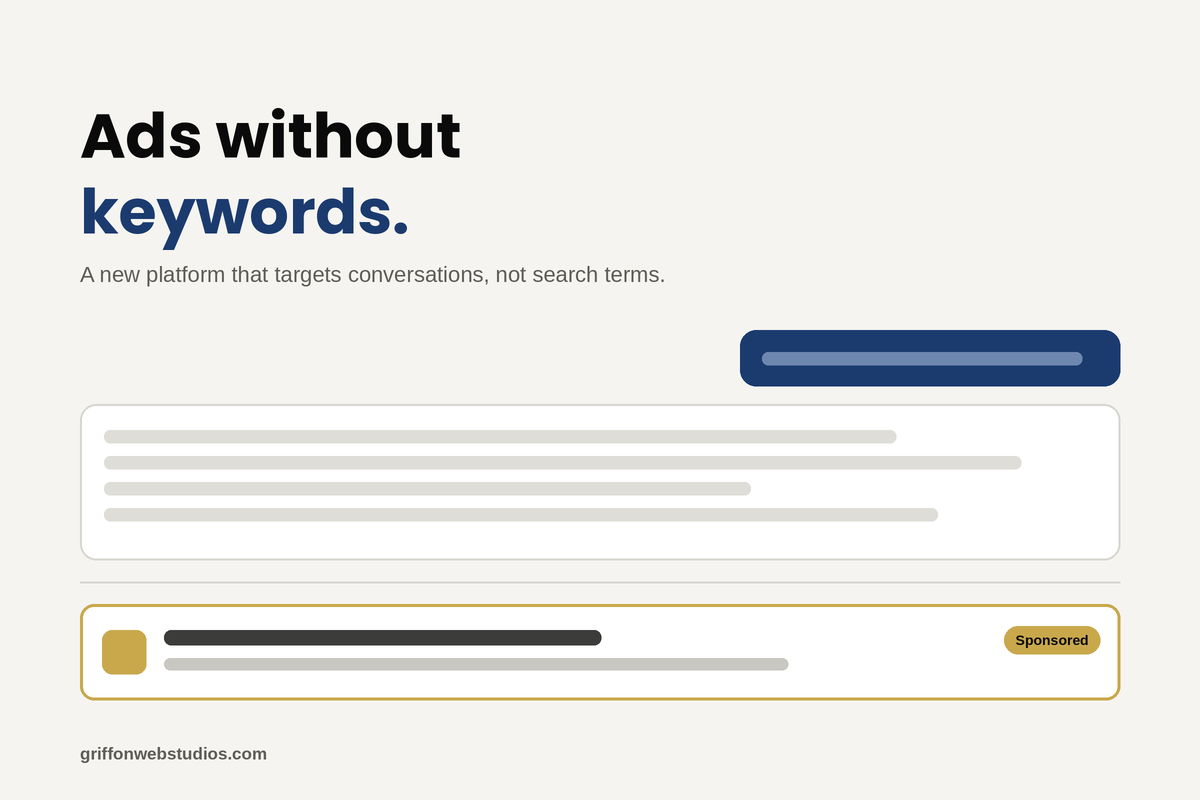
This is where most advertisers get it wrong on the first attempt. The instinct is to paste in a keyword list. The system is semantic, not keyword based, so a list of fragments gives it very little to work with. What performs better is a description of a situation: the kind of person, the problem they are working through, and the decision they are trying to make. Write it the way you would describe your ideal customer to a new employee, not the way you would build a keyword group.
Beyond context hints, your levers are geography, your own first party data, and the wording of your ad and landing page. Landing page relevance appears to factor into whether you win placement, which will feel familiar to anyone who has worked with quality scoring on other platforms.
What it costs, and how confident to be about that
Reported benchmarks cluster around a few dollars per click, with guidance in the range of three to five dollars, and CPM figures circulating in the vicinity of sixty dollars. Treat those as directional rather than reliable. The platform is young, competition varies enormously by category, and benchmark numbers published during a land grab phase tend not to survive contact with a crowded auction. Your own first thirty days of data will be worth more than any published average.
What is more useful than a benchmark is the reasoning behind the price. Clicks in ChatGPT cost more than social clicks because the person is usually in the middle of working something out rather than passively scrolling. Whether that intent premium is worth paying is exactly the question the next section answers.
Who this is actually for right now
Here is the part most coverage will not tell you, because “new platform, act now” is a more exciting article.
If you are a local service business, this is probably not where your next dollar belongs. Someone searching for an emergency plumber is not deliberating in a chat window, they are searching and calling. Your highest return spending remains search, where intent is explicit and immediate, and your Business Profile and local placements, where local buyers actually decide. Test ChatGPT Ads with money you can afford to learn from, not with budget moved out of a channel that is producing.
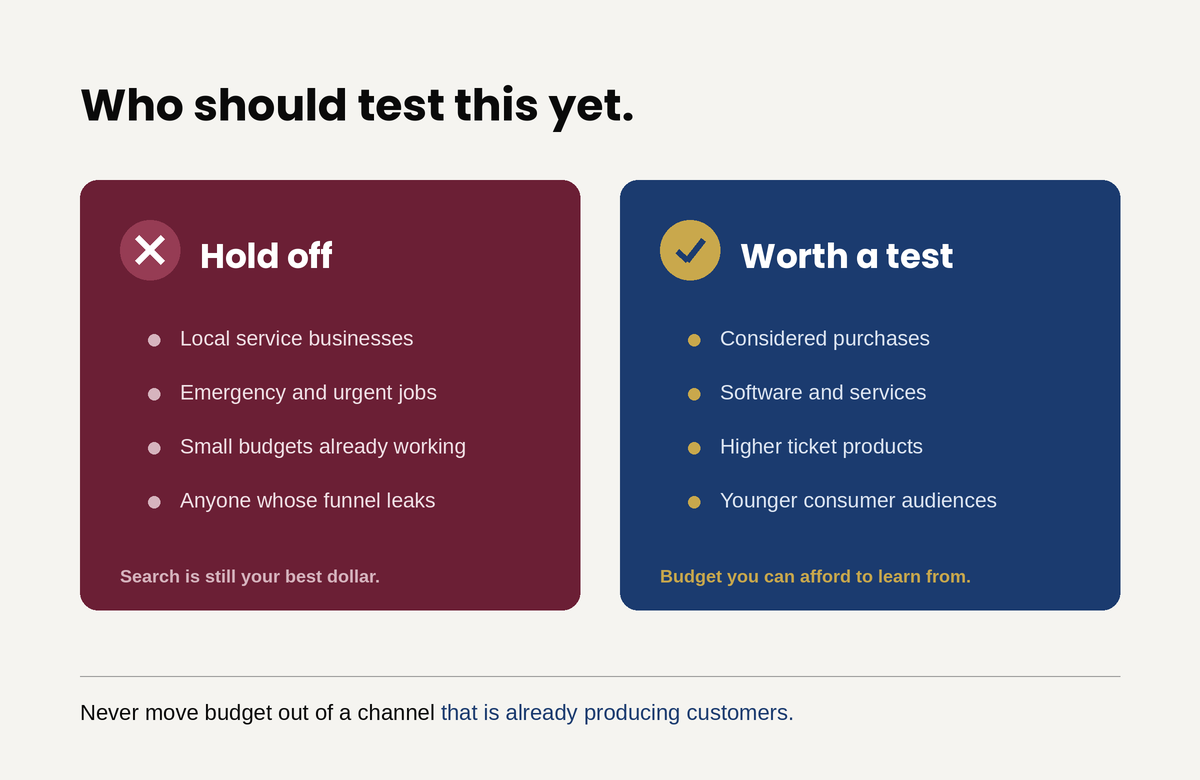
If you sell something people research before buying, the case is stronger. Considered purchases, comparisons, and category education are exactly the conversations happening inside these tools. Software, professional services, and higher ticket products fit the format better than impulse purchases do.
If you sell to consumers on the younger end, note the audience skew. Ads serve to free and lower tier users, and ChatGPT’s user base skews younger than the general population. That is an advantage for some businesses and a mismatch for others.
And if your paid media is currently leaking, fix that first. Adding a new platform to an account that is already wasting budget on placements nobody chose multiplies the problem instead of solving it.
How to test without wasting money
If you do test, run it as a test rather than a launch.
Start with the Clicks objective. You get faster feedback on what people actually respond to, and you can measure downstream conversion from the first week. Impression based buying needs more volume and more patience before it tells you anything.
Set a budget you would be comfortable writing off entirely, because that is the honest framing for any channel with no track record in your category.
Write context hints as scenarios, not keyword lists. Describe the person, their situation, and the decision. Specificity beats breadth here: hints that are too generic tend to lose relevance scoring to better targeted advertisers.
Match your landing page to the hint. If the context describes someone comparing options, sending them to a generic homepage wastes the click. This is ordinary conversion discipline, and it applies with more force on a platform where relevance appears to influence delivery.
Give it enough time and volume to produce a signal, then judge it on cost per acquired customer rather than cost per click. A cheap click on a new platform is still a cost, not an outcome.
Expect the product to keep changing. Formats, targeting options, and availability have all shifted repeatedly since launch, and anything you read about this platform, including this article, has a short shelf life.
The part that has not changed
A new ad platform does not change the arithmetic underneath it. You are still buying attention, and attention still has to survive contact with your website and your follow up before it becomes revenue. A ChatGPT click that lands on a slow page or generates a lead nobody calls back is the same waste it would be from any other source, except now it is arriving from a channel with less proven performance.
The businesses that will do well here are the ones that already have their conversion path in order and are adding a channel to a working machine. The businesses that will conclude ChatGPT Ads does not work will mostly be the ones whose funnel was already leaking before they arrived.
Should you try it?
This is a real platform with real scale, growing faster than almost any advertising product in recent memory, and it is worth understanding now rather than in a year. It is also early, its costs are unsettled, and its best fit is a specific kind of business rather than every business.
Understand it now. Test it with money you can lose. Do not move budget out of a channel that is currently producing customers in order to chase a channel that has not yet proven it can.