
A redesign is the most common way a business quietly wrecks its own search traffic. The damage is almost always preventable, and it comes down to what you preserve, not what you change.
The new site launches. Everyone admires the cleaner look. Six weeks later organic traffic has fallen off a cliff, the leads have thinned out, and nobody connects the two events, because the redesign was a triumph and this is just some unrelated slump. It is not unrelated. A redesign is the single most common way a healthy website destroys its own search performance, and it happens for a simple reason: a redesign gets treated as a visual project when it is also, invisibly, a technical SEO project.
The site ends up looking better and ranking worse. (If your traffic has already dropped after a relaunch, diagnosing exactly what broke is a separate and solvable problem. This article is about not getting there in the first place.)
The good news is that almost none of this damage is necessary. Prevention is straightforward, and it is far cheaper than recovery. Here is how redesigns kill rankings, and how to keep yours intact.
Why a redesign quietly kills rankings
The root cause is rarely technical. It is organizational. The people designing the new site and the person responsible for its search performance usually never talk. The designers optimize for how the site looks and feels, which is their job. Nobody is assigned to protect what already ranks. So the things that carry your search equity, your URLs, your content, your internal links, and a stack of technical signals, get changed or discarded as a side effect of making the site prettier. The client finds out when the traffic craters, by which point the cause is weeks old and hard to trace.
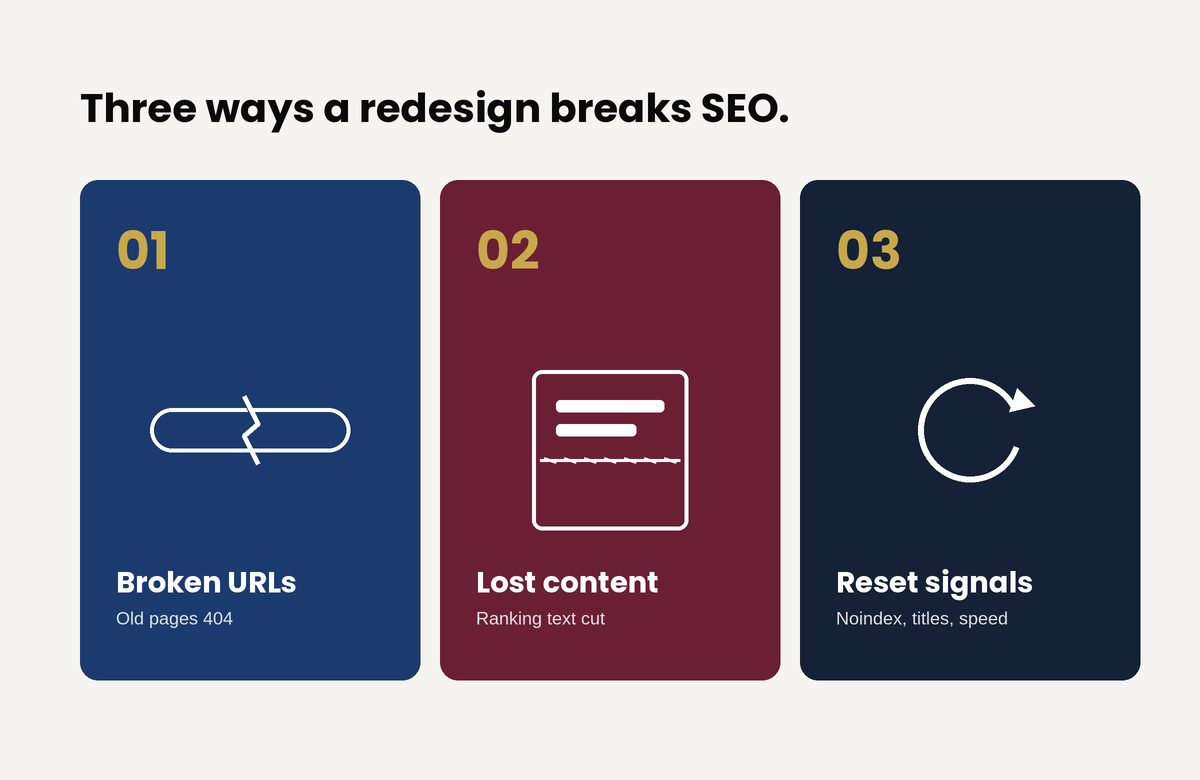
That single gap produces three failure modes. Each is common, each is preventable, and each stays invisible until it gets expensive.
Failure one: the URLs change and nobody maps the redirects
This is the most catastrophic and the most common. Every page that ranks lives at a specific URL, and everything that gives that page its ranking, Google’s index and every backlink pointing at it from across the web, is attached to that exact address. A redesign, especially one that moves to a new CMS or restructures the navigation, frequently changes those addresses. The product page that lived at one path now lives at another.
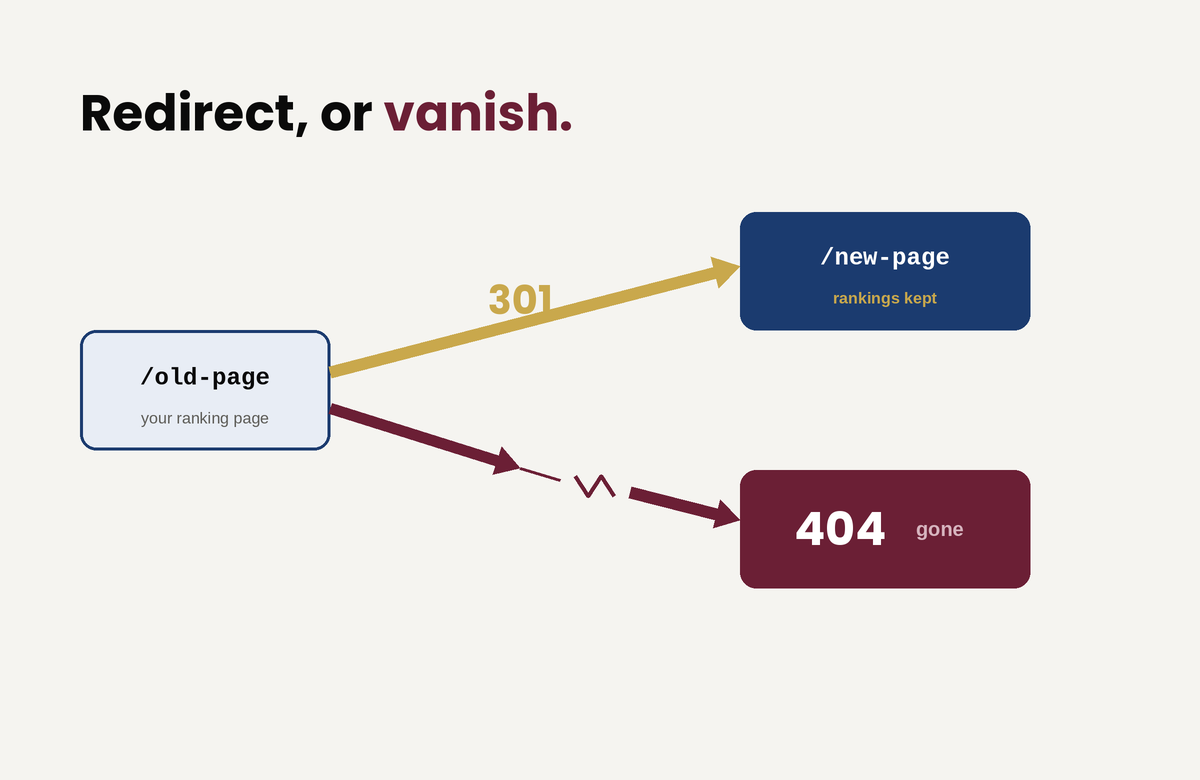
If the old URLs are not redirected to their new equivalents, every old address becomes a 404, the rankings attached to those addresses evaporate, and years of accumulated link equity is severed in an afternoon. The reassuring part, and the part most people have backwards, is that the redirect itself costs you nothing: Google is explicit that a permanent (301) redirect does not cause a loss in ranking signal. The danger is never the redirect. It is the missing redirect.
Recommendation:
So before launch, crawl the existing site, inventory every URL that earns traffic or holds links, and map each one to its new destination with a permanent redirect. Two traps wait here. The first is redirect chains, where an old URL points to a second URL that points to a third; Google recommends redirecting straight to the final destination and keeping any chain short. The second is worse and oddly common: redirecting every old URL to the new homepage. Google warns against this directly, because it collapses the distinct topical signals of all those pages into one, and that topical equity does not transfer, it disappears. A page about a specific service has to redirect to the equivalent page, not to the front door.
The safest move of all is to not create the problem. If your URLs can stay the same through the redesign, keep them. The lowest-risk redesign changes the design and leaves the addresses alone.
Failure two: the content gets “cleaned up” and the words that ranked vanish
Redesigns love whitespace and brevity. The instinct is to trim copy, replace blocks of text with imagery, and simplify pages down to something that breathes. The problem is that the text being trimmed is frequently the exact text that ranks. Google ranks a page on its content, so strip a page of the words it ranked for and it stops ranking for them. Replacing indexable copy with text baked into an image makes it worse, because Google reads that text poorly if at all.
This is not an argument against clean design. Good design and substantive content are not in conflict; a page can be clear, spacious, and still carry the words that earn its traffic. But before anyone cuts, someone has to know which content does the earning. Preserve the real copy on pages that rank, keep the heading structure and the terms those pages are known for, and never bury indexable text inside graphics. A cleaner design does not require less content. It requires better-organized content.
Failure three: the technical signals reset on launch
The third failure is a bundle of smaller ones that ship together on launch day. The most infamous: a developer correctly blocks the staging site from search engines, the new site goes live, and that block ships straight to production, telling Google to ignore the entire site. Google’s own guidance tells you to clear every temporary crawl block before the move, yet teams skip that step constantly.
The rest of the bundle stacks up fast. A new build regenerates your title tags and meta descriptions into bland theme defaults and wipes out the optimized ones.
- It points canonical tags at the wrong page.
- It leaves the new XML sitemap unsubmitted, or quietly drops the old one.
- It loads a heavier, slower theme until Core Web Vitals collapse.
- It discards your structured data.
And it flattens your internal linking until the architecture that once distributed authority across the site disappears. Almost none of this shows on the front end: a human visitor sees a flawless site, while a crawler sees a broken one. That gap is exactly why “it looks fine to me” is not a verdict on SEO.
The fix is a pre-launch checklist that carries every optimized signal across to the new build, and a post-launch crawl that catches whatever slipped through anyway.
How to redesign without the damage
A redesign that protects search equity follows an order. It is not complicated, but it has to be deliberate.
Benchmark before you touch anything. Record current rankings, organic traffic, your top pages, and your most-linked URLs. You cannot tell whether you broke something if you never wrote down what working looked like.
Build on a staging environment that is blocked from indexing but crawlable by you, so you can test the full site privately, and put removing that block on the launch checklist so it does not ship live.
Map every URL one-to-one. Keep the addresses that can stay, redirect the rest to their true equivalents with permanent redirects, allow no chains, and never funnel everything to the homepage.
Preserve the content and on-page signals that earn rankings: the substantive copy, the headings, the title tags and meta descriptions, the canonicals, the structured data, and the internal links.
Launch, then move immediately.
Submit the new sitemap through Search Console, request indexing of your key pages, crawl the live site to catch 404s, redirect chains, stray noindex tags, and broken canonicals, and then watch Search Console daily for the first couple of weeks and weekly after that.
One discipline saves more grief than any other: do not stack everything at once. Google’s standing advice is to change one thing at a time, because combining a redesign with a domain change and a content overhaul makes it almost impossible to tell which one broke things when something inevitably wobbles. If you can phase the work, phase it. (And if the redesign does involve moving to a new domain, that move has its own requirements, including Google’s Change of Address process.)
Finally, expect a temporary dip even when you do everything right. Google says plainly that rankings fluctuate during a move and that a medium-sized site can take weeks to fully settle in the index. That wobble is normal. Hold steady and resist the urge to start frantically changing things, because panic edits during the settling period only muddy the signal you need to read.
The one rule that prevents most of it
If you take nothing else from this: do not change URLs unless you have to, and redirect every single one you do change. Keep those redirects live for at least six months, and longer while they are still receiving any traffic from search. That one discipline, applied properly, prevents the large majority of redesign disasters before they start.
A redesign should be an upgrade, not a reset
The new site can look nothing like the old one and still keep every point of search equity it had. The two goals only conflict when nobody is responsible for the second one. The fix is not more technical skill on launch day. It is assigning someone to protect the site’s search performance from the very first mockup. It is treating that protection as a requirement of the project rather than a question raised after the traffic falls.
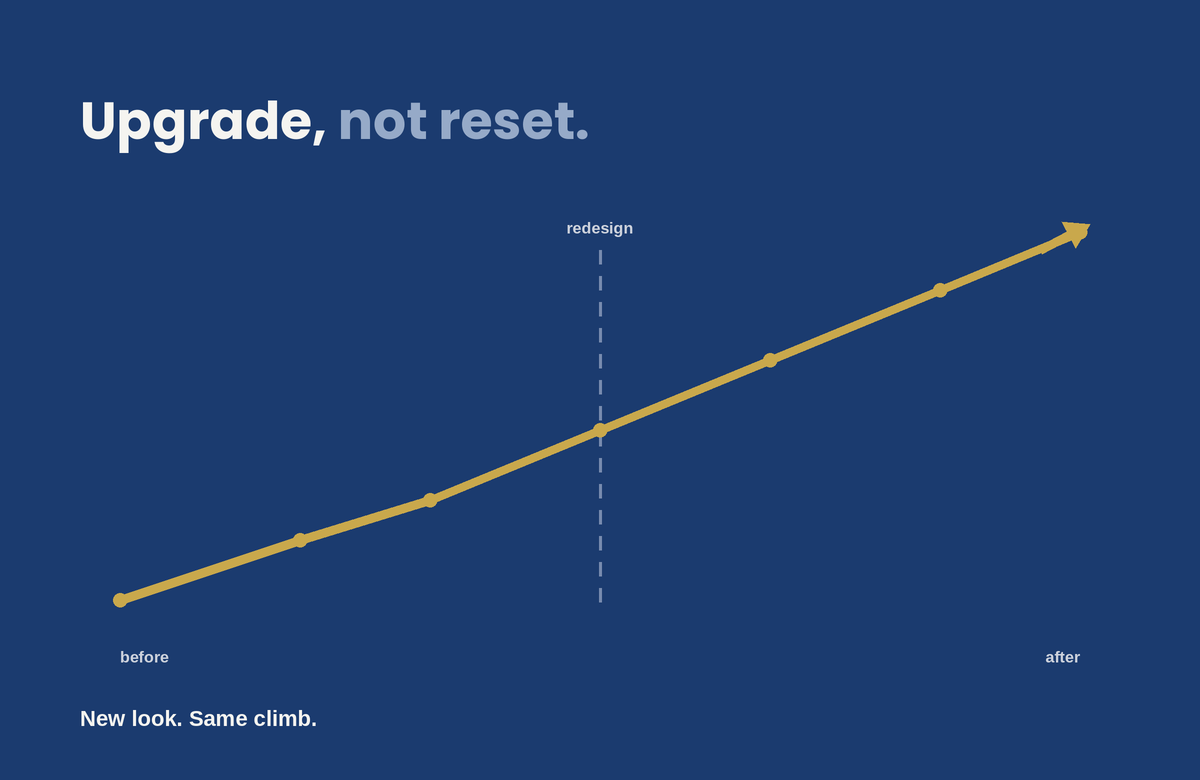
A redesign that respects both the design and the SEO is entirely achievable. You just have to plan it that way from the start.