
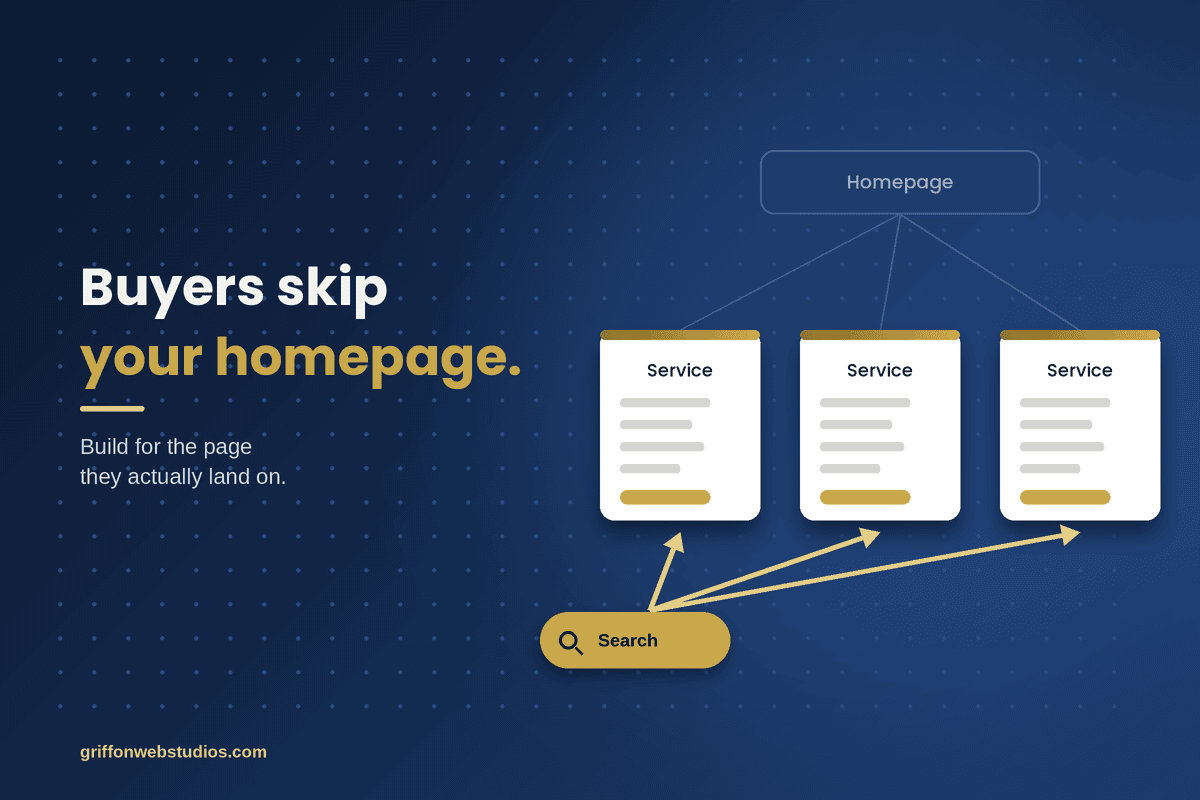
Ask a service firm what matters most on its website and the answer is almost always the homepage. It gets the most design attention, the most internal debate, the most revisions, and usually the largest share of the budget. Then open the firm’s analytics, look at which pages people actually arrive on, and a different picture appears. For many firms, the homepage is not where most serious visitors start. It is where existing clients go to find the login link, where job applicants go to find the careers page, and where people who already know your name go to check your phone number.
The buyer who has never heard of you, who searched for the specific thing you do and is deciding whether to contact you, very often never sees your homepage at all. They land directly on a service page, read it, and make a decision. If that page is thin, generic, or written as an afterthought, the homepage you spent months perfecting never gets its chance.
Check your own numbers first
Do not take this on trust, including from this article. The evidence is in your own analytics and takes two minutes to find.
In Google Analytics, open the landing page report and sort by sessions. Then sort by key events, the actions you have defined as meaningful, such as inquiry form submissions and calls. Look at what share of your inquiries began on a page other than the homepage. For firms with a meaningful amount of search traffic, that share is often substantial, and it tends to be highest for exactly the visitors you most want: people who arrived from a search describing a specific service.
This is not a new pattern. As far back as 2008, usability researcher Jakob Nielsen was reporting that only around a quarter of web visits passed through a homepage, with the rest arriving deep inside sites directly from search. Search has only become more specific since then, and AI search is accelerating it further: as AI summaries absorb general informational queries, the visitors who do click through increasingly arrive with a specific need, on a specific page.
Why service pages get neglected
The homepage gets attention because it is the page everyone in the firm looks at, and the page every stakeholder has an opinion about. Service pages get written once, often by whoever had time, and are rarely revisited. The result is a familiar pattern.
There is often a single “Services” page listing everything the firm does in short paragraphs, which serves no individual service well and ranks for none of them. Where individual pages exist, they tend to run a few hundred words describing what the service is rather than what the buyer needs to know, open with the firm’s history instead of the client’s problem, and end with “contact us” and nothing else. They carry a stock photograph that could belong to any firm in any industry, and a testimonial that does not mention the service at all.
None of this is visible from the homepage, which is why it survives redesign after redesign.
What a buyer is actually trying to find out
Someone landing on a service page from search is not browsing. They are trying to answer a short list of questions, roughly in this order, and they leave as soon as the page stops answering them.
Is this the thing I searched for? The first screen should confirm, in plain language, that this page is about the specific service they need and the kind of client it is for. Not your firm’s mission. Not a slogan. The service and the situation it solves.
Do these people understand my problem? Buyers trust firms that describe their situation more precisely than they could themselves. A page that names the specific pressures, trigger points, and common mistakes involved signals expertise far more convincingly than a list of credentials.
What actually happens if I hire them? Scope, process, timeline, and who does the work. This is the section most service pages skip and most buyers want most, because the unknown is the risk. A clear outline of the engagement, from first conversation to delivery, removes a large share of hesitation.
Roughly what will this cost? Many firms avoid pricing entirely, and there are legitimate reasons not to publish a fixed number for custom work. But saying nothing forces the buyer to guess, and many will assume you are out of reach and leave. A starting range, the factors that drive cost, or a plain explanation of how pricing works keeps serious buyers on the page and filters out poor fits before they consume your time.
Have they done this before, for someone like me? Proof needs to be specific to the service. A general testimonial about being “great to work with” carries far less weight than a short account of a comparable problem and what changed. If client confidentiality limits what you can name, describe the situation and the outcome without identifying anyone.
What is the risk of reaching out? The final step should match how ready the visitor is. A buyer still evaluating options may not want a sales call; a short form, a clear explanation of what happens after they submit it, or a lighter first step can capture people a single “book a consultation” button would lose.
The orientation problem
A visitor who lands on a service page directly has skipped everything you put on the homepage to introduce the firm. They do not know who you are, where you work, or what else you do. Every service page has to quietly carry that context: a short line establishing who the firm is, clear navigation to related services, and enough trust signals that a cold visitor does not need to go back to the homepage to decide whether you are credible. Treat each service page as a front door, because for a large share of your buyers it is the only one they use.
The search side of the same problem
The structural decisions that serve buyers also serve search, which is convenient, because they are often the same decision.
One service, one page. A single page covering six services cannot rank well for any of them and cannot answer six different sets of buyer questions. Separate pages give each service a clear subject, a clear target, and room for the depth buyers need. Google’s SEO Starter Guide makes the same underlying point about organizing content so that each page has a clear purpose.
Write the title for the person searching. The page title and heading should describe the specific service in the words a buyer would use, not an internal label or a clever line. Google uses these signals when generating the title link shown in search results, and a precise title is also what persuades someone to click.
Depth is substance, not length. Google’s guidance on creating helpful, people-first content repeatedly emphasizes first-hand expertise and content that fully answers the reader’s need. A service page that genuinely answers the buyer questions above will naturally be more substantial than the typical three paragraphs, without any padding.
Point your other content at it. Blog articles and resources should link to the relevant service page in context, with descriptive anchor text, so both readers and search engines understand which page represents that service. Many firms build up dozens of articles that link to the homepage or to nothing at all, which wastes the authority those articles accumulate.
Rebalancing the budget
None of this means the homepage does not matter. It still serves returning visitors, referrals, and people who search your name, and it sets the tone for the brand. But if your landing page data shows that serious buyers are arriving elsewhere, the investment should follow them.
A practical approach is to rank your service pages by the commercial value of the service and the volume of visitors they already receive, then rebuild them in that order: the highest value services first, with the full set of buyer answers, specific proof, honest pricing signals, and a next step matched to the visitor. One substantially better service page will often do more for inquiries than another round of homepage refinements. And if a broader redesign is planned anyway, make sure the service pages are treated as primary pages in that project rather than templates filled in at the end, and that the redesign protects the rankings those pages already hold.
How to know it is working
Measure each rebuilt page against its own baseline rather than against the site as a whole. Track inquiries that begin on that page, the share of visitors who reach the contact step, and whether the inquiries that arrive are better qualified. Expect the clearest signal from inquiry quality rather than volume: a page that answers scope and pricing questions honestly often produces fewer but far better conversations, which is the point. Engagement figures are useful diagnostics, but the numbers that matter are the ones closest to revenue.
Your homepage is where you introduce the firm. Your service pages are where buyers decide whether to hire it. Most websites invest in the opposite proportion to where decisions are actually made. Open your landing page report, see where your best inquiries begin, and spend accordingly. The page that deserves your next round of attention is very likely not the one everyone in the firm is looking at.