
Why Customers Trust AI Answers More Than Brand Websites

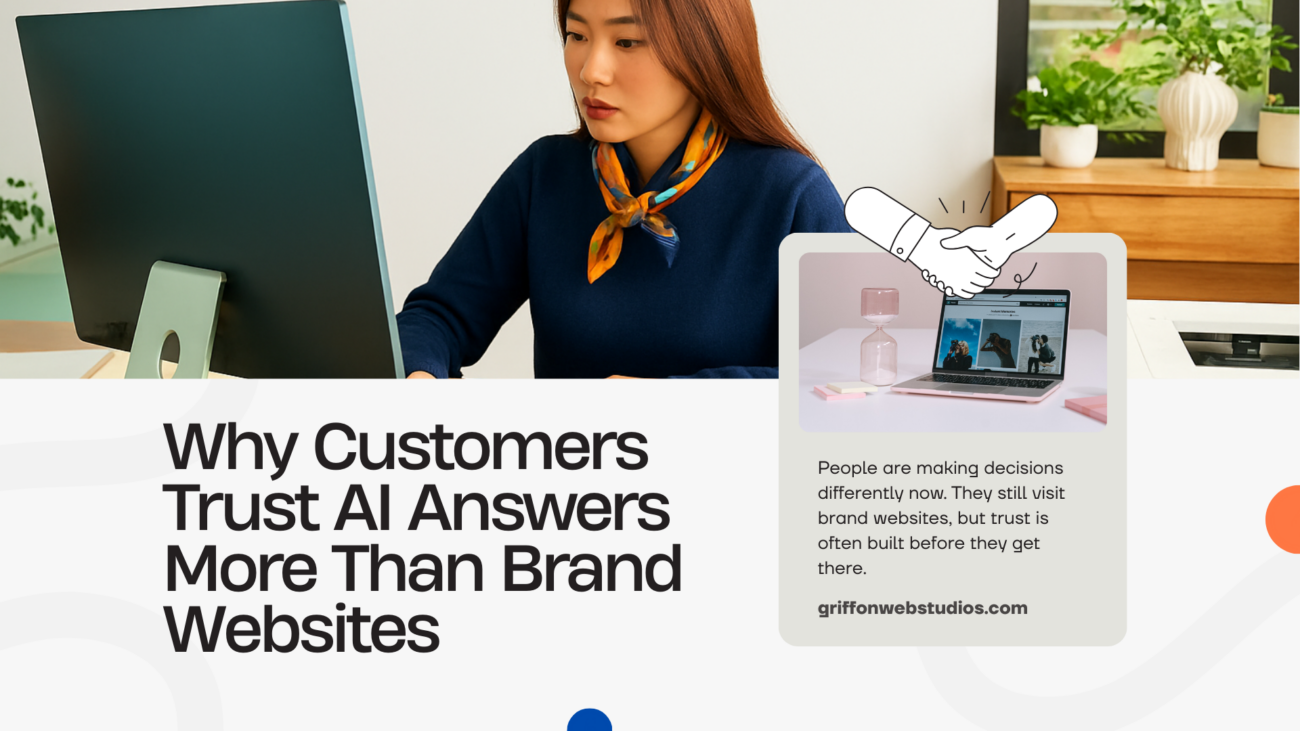
Why Customers Trust AI Answers More Than Brand Websites

People are making decisions differently now. They still visit brand websites, but trust is often built before they get there. Most people use AI tools, search summaries, and quick answers to sort through their options. They read, compare, and narrow things down before ever clicking through to a brand’s site. By the time they arrive, they’ve usually made up their minds or are close to it.
This is a crisis of trust, not technology.

AI feels neutral. Brand websites don’t.

When someone visits a brand’s website, it’s obvious the content is written by the brand. The goal is to persuade. Even if the facts are accurate, the intent is clear.
AI answers feel different.
AI answers show up as summaries, comparisons, or explanations, not sales pitches. There’s no call to action, no banners, no obvious sales talk. The tone feels neutral and balanced. Whether that’s truly the case is another question, but the perception of neutrality is what matters here.
People tend to trust information they see as objective, especially when they’re comparing options.

Speed and effort matter more than depth

AI answers build trust by making the process simpler and helping users understand information more easily.
Reading several long blog posts, learning marketing terms, and comparing product features takes a lot of time. AI tools can create short summaries, saving users from extra work. The answer just needs to be good enough for a decision, even if it’s not perfect.
People don’t need detailed research results in their searches anymore. They want:
  • clarity
  • direction
  • reassurance
AI provides these things faster than most websites.

Customers aren’t leaving websites; they’re using them differently.

Many brands don’t see what’s really happening at this stage.
People still visit websites, but their purpose has changed. In the past, websites helped build trust. Now, they confirm trust that’s already been established.
Users feel more confident when a website matches what they’ve already seen in AI summaries, search results, or peer discussions. If the site doesn’t match, users lose trust and leave quickly.
This is why many businesses see:
  • lower time on site
  • faster decisions
  • Websites have high bounce rates because users are ready to buy.

Generic messaging collapses under AI summaries

AI tools don’t value nuance. They condense information.
When AI summarizes brand websites, it often turns unique claims into the same generic phrases like ‘full-service’ or ‘custom solutions.’ The differences between brands get lost. In the end, everyone sounds the same.
The trust between people breaks down at this point.
AI answers get more trust when brands are generic, because there’s nothing specific to work with. Brands that stick to clear, concrete details are more likely to stand out, even when information gets compressed.

Authority now travels beyond owned platforms

Authority used to live on your own website. Now, it’s spread across many channels.
It shows up in:
  • The number of times your professional expertise appears across the entire internet.
  • whether your explanations are clear enough to be summarized accurately
  • whether your brand has a recognizable point of view
People trust AI answers because they pull from many sources, not just one. If a brand only shows up on its own site, it’s hard to build real trust.

What this means for businesses

The way people interact with information is changing. Building trust now means meeting people where they are, not forcing them through extra steps.
That means:
  • explaining what you do in plain, specific language
  • avoiding inflated or interchangeable claims
  • What you say on your website should line up with how you describe your brand everywhere else.
  • Website design should help people do what they already want to do, not make them change how they work.
Trust now forms upstream. Websites that assume users are starting from zero are out of sync with reality.

The quiet opportunity

The brands that succeed in this environment won’t be the loudest. They’ll be the clearest.
Their value will be clear, even after information gets compressed. Their online presence will reach people who already know what they offer.
Now, the focus is on connecting strategy, messaging, and user experience so the digital presence actually works.
We’ve seen this play out with our clients at Griffon Webstudios. When websites confirm what people already know rather than over-explain, trust goes up, and conversion rates improve, even if traffic patterns change.
How Voice, Visual, and AI Searches Are Redefining Discovery

How Voice, Visual, and AI Searches Are Redefining Discovery

The way people search for information is no longer about typing words into a box.

We’re entering a new era of discovery one where people talk to devices, point their cameras, or ask AI assistants to find what they need. Search has evolved from a static keyword process into a fluid, conversational, and intelligent experience powered by context, not syntax.

This shift doesn’t just change how people search. It transforms how brands get found.

1. The Voice Search Revolution

Voice search has quietly become one of the most influential disruptors in how users discover brands.

According to Google, more than 50% of all smartphone users use voice commands daily. It’s easy, hands-free, and natural especially as voice assistants like Siri, Alexa, and Google Assistant have become household companions.

The key insight?

Voice search reflects how humans actually talk, not how we type. Traditional SEO revolved around phrases like “best Italian restaurant NYC.” Voice search transforms that into:

What’s the best Italian restaurant near me that’s open right now?”

That one extra clause “open right now” carries massive implications.

Voice queries tend to be:

    • Conversational: full sentences, not fragments.
    • Local: most voice searches have a location intent (“near me”).
    • Action-driven: users want results they can act on immediately.

How brands should adapt

    • Write for how people talk. Use natural phrasing and long-tail queries in your content.
    • Focus on featured snippets. Voice assistants often read the top answer the “position zero” on Google.
    • Optimize for local SEO. Keep your Google Business Profile accurate and filled with conversational keywords (“Best coffee near Brooklyn Bridge”).
    • Add FAQ sections. Structured Q&A content maps beautifully to how voice assistants process data.

Voice discovery is no longer about being seen. It’s about being spoken aloud. And there’s only room for one answer in most voice results.


2. Seeing Is Believing: The Rise of Visual Search

The camera is the new search bar. Platforms like Google Lens, Pinterest Lens, and Snapchat’s Scan have turned cameras into tools of discovery. Point, snap, and you instantly know what something is, where to buy it, and how others use it.

Visual search appeals to how people naturally engage through images, not text. Research shows that 62% of Gen Z and Millennials prefer visual search over any other format when shopping online.

Why it matters

Visual search isn’t replacing keywords it’s enhancing them. It allows users to skip the description process entirely. Instead of typing “tan leather crossbody bag with gold chain,” they can just take a photo.

That simplicity changes everything for eCommerce, hospitality, and lifestyle brands.

How to optimize for visual discovery

    • Use high-quality, consistent imagery. Search algorithms analyze color, shape, and texture.
    • Name your images descriptively. “black-satin-evening-dress.jpg” beats “IMG_0045.jpg.”
    • Add alt text and structured data. Describe what’s in the image, AI learns context through language.
    • Use product schema. Structured metadata like brand, price, and availability makes your products machine-readable.
    • Ensure cross-platform consistency. Your logo, packaging, and color palette should be recognizable to image-based search engines.

Visual discovery rewards brands that look good and think smart. It’s no longer just about aesthetics; it’s about accessibility, creating visuals that are easy for machines to identify and humans to connect with.

3. The Age of AI Search: When Algorithms Become Curators

The biggest change to search isn’t how we speak or see, it’s how machines think. AI-driven search, powered by models like ChatGPT, Google Gemini, and Perplexity, has rewritten how people consume information. Instead of showing a list of links, these systems generate answers often summarizing insights from multiple sources.

That shift changes the nature of discovery. Visibility is no longer about ranking; it’s about being referenced.

The new hierarchy of visibility

AI search models don’t just crawl the web. They learn from it. That means the content they trust becomes the foundation for future results.

Your website might not appear as a link but if AI uses your content to form an answer, you’ve still won. The key is to become part of the model’s knowledge graph, the web of verified, authoritative information it draws from.

How to optimize for AI-driven discovery

    • Create original, factual, and verifiable content. AI engines prioritize trustworthy, human-authored material.
    • Focus on topical authority. Cover your niche comprehensively, interlink related pages so AI understands context.
    • Use structured data. Schema markup makes it easier for AI to parse your content into meaningful relationships.
    • Publish educational insights. Think “how” and “why” content over “what” content, teaching AI, not selling to it.
    • Build brand mentions. When other reputable sites reference your company, you increase your likelihood of inclusion in AI responses.

AI doesn’t reward noise; it rewards clarity. Brands that provide structured, reliable, and human-verified content will become trusted sources for machine-driven discovery.


4. How Search Behavior Is Fragmenting

These new modalities- voice, visual, and AI aren’t replacing traditional search. They’re coexisting and overlapping.

A single user journey might now look like this:

    1. They ask Siri for options.
    2. They scan an image of something they like.
    3. They consult ChatGPT for a summary before deciding.

That means discovery is no longer a straight line. It’s a web of micro-moments happening across devices and platforms.

For marketers, this fragmentation requires a mindset shift. Instead of optimizing for one search channel, you need to optimize for intent, understanding what users want at each stage and ensuring your content or experience aligns with it.

Example flow:

    • Voice: “Where can I find lightweight travel backpacks?”
    • Visual: Uploads photo of a friend’s backpack to Google Lens.
    • AI: “Compare best travel backpacks under $200.”

A brand that wins in all three contexts isn’t the one with the loudest ads. It’s the one that’s visible, relevant, and trustworthy across modalities.


5. The New SEO Framework: Context, Structure, and Intent

Traditional SEO was about matching keywords.

Modern SEO is about aligning with meaning.

To thrive in this new ecosystem, your digital presence must be semantically rich, built around concepts, entities, and structured relationships that search systems can easily interpret.

Three layers of modern SEO:

1. Contextual Optimization:

    • Use natural language.
    • Write content that answers questions, not just ranks for phrases.
    • Group related ideas together so AI sees depth.

2. Structured Data:

    • Add schema for products, reviews, FAQs, and organization info.
    • Connect content through internal linking.
    • Keep metadata descriptive and machine-readable.

3, Intent Alignment:

    • Create content for discovery (“What is…”), consideration (“Best ways to…”), and action (“Buy now”).
    • Match tone and format to the search mode. Conversational for voice, visual-first for image, authoritative for AI.


The Future of Discovery

The next phase of search will be less about finding information and more about interpreting it. We’re moving toward multimodal discovery, where systems blend text, image, audio, and video understanding to infer intent in real time. Google’s Multisearch already allows users to combine text and image queries (“Show me this dress in blue”). AI chat interfaces will soon merge these modes seamlessly.

For brands, this means success will hinge on content diversity and semantic integrity:

    • Having your ideas represented visually, verbally, and contextually.
    • Ensuring your brand’s meaning, not just its content, is machine-readable.

The brands that win will be those that think holistically about discoverability: human-first, AI-understandable, and contextually relevant across formats. At Griffon Webstudios, our work sits at the intersection of design and intelligence, helping brands translate their story seamlessly across the evolving landscape of voice, visual, and AI search.

Get Your Website Picked Up by AI Search Engines

Get Your Website Picked Up by AI Search Engines

The way people search for information online is changing fast. Traditional search engines still matter, but more users are now turning to tools powered by artificial intelligence that deliver direct, conversational answers instead of just links. If your website isn’t optimized to be visible in these new systems, you risk losing a massive share of traffic to competitors who adapt quicker.

So how do you make sure your business shows up on AI Search Engines? Let’s break it down.

What Makes AI Search Engines Different?

Unlike Google’s classic algorithmic ranking system that prioritizes backlinks and keyword density, AI search engines like Perplexity, Google AI, and even ChatGPT’s browsing capabilities are designed to understand context, intent, and authority at a much deeper level. They pull from multiple sources, synthesize information, and deliver it back to the user in a natural way.

That means the old tricks like keyword stuffing, thin content, or chasing backlinks won’t cut it anymore. Instead, success depends on how well your website communicates expertise, clarity, and structured knowledge.

Step 1: Build Content That AI Can Understand

AI thrives on clarity. To improve your chances of being featured in an AI search engine result:

    • Write in plain, direct language that answers questions fully.
    • Anticipate user queries-what’s the exact question your customer would type or speak? Then answer it directly in your content.
    • Use headers and sub-headers to create clean structure. AI crawlers love clear hierarchy.

Think of your website like a teacher’s guide: the clearer you explain, the more likely AI is to quote you.

Step 2: Strengthen Your E-E-A-T

Google introduced E-E-A-T (Experience, Expertise, Authoritativeness, and Trustworthiness) years ago, and now AI search engines are adopting similar principles. They want to showcase information that’s reliable and backed by authority.

Ways to build this:

    • Add author bios showing real-world expertise.
    • Cite reputable sources and link out where necessary.
    • Publish case studies, testimonials, and data-driven insights to prove your credibility.

AI systems weigh your reputation heavily before pulling your site into an answer.

Step 3: Use Structured Data

Schema markup isn’t just for Google. AI search engines use it too. Structured data gives AI context on what your product is, what your article covers, who wrote it, and more.

For example, adding FAQ schema to a service page makes it more likely that AI will surface those Q&As in a conversational result. Similarly, product schema ensures your listings can be recognized as official and accurate.

Step 4: Cover Topics in Depth, Not Just Keywords

If AI is trying to summarize the web, shallow content won’t make the cut. Instead of writing a 300-word blog post stuffed with keywords, go deeper. Address related questions, explore “what if” scenarios, and include actionable takeaways.

Example: If your keyword is “domestic battery defense attorney, don’t just define what the term means. Go further and explain the types of charges, possible defenses, the legal process, what clients should expect in court, and common misconceptions. A page that thoroughly answers these connected questions is far more likely to be chosen by an AI search engine than one with just a brief definition and contact info.

AI favors sources that give complete, well-rounded answers.

Step 5: Optimize Beyond Google

Yes, Google is experimenting with AI Overviews, but don’t stop there. Platforms like Perplexity, ChatGPT with browsing, and niche AI search engines are gaining users quickly. Make sure your brand appears wherever your customers might be searching.

That could mean:

    • Publishing on multiple platforms (Medium, LinkedIn, Quora).
    • Ensuring your website is crawlable and fast.
    • Staying active with authoritative guest posts and thought leadership.

The more touch points you create, the more likely AI will recognize your site as a trusted source.


Getting Picked Up by an AI Search Engine

This isn’t about gaming the system, it’s about making your website the kind of resource AI wants to recommend. If your content is clear, authoritative, and well-structured, you stand a strong chance of being surfaced in conversational results that millions of users now rely on.

Search is evolving, but visibility is still the name of the game. The difference is that now you need to think about how both humans and machines read your content. Those who adapt fastest will own the next era of online discovery.