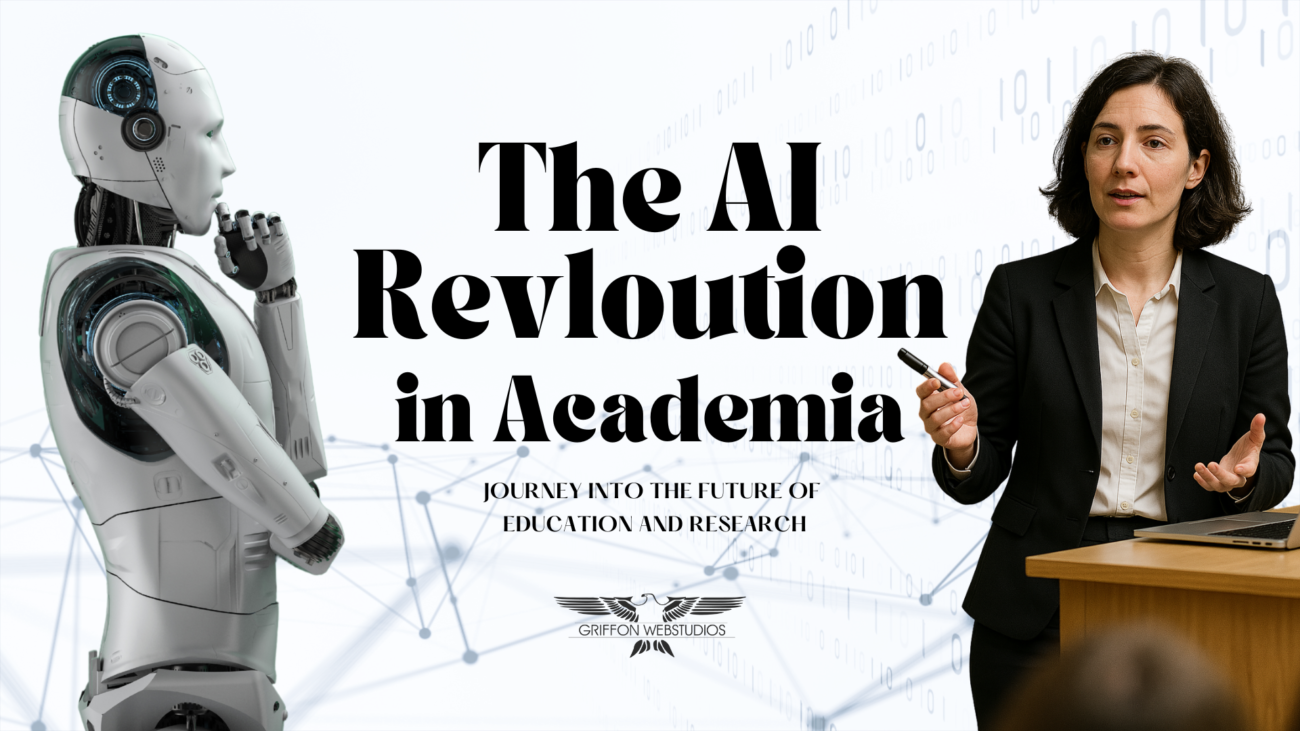
Dr. Elise Oray stood at the front of her first college lecture after earning her professorship at a top university in New York, feeling a mixture of excitement and nervousness. Elise had dedicated her life to both learning and research after more than ten years of academic life. But something had changed. Every method, every tool and every question in the field experienced changes. The catalyst? Artificial Intelligence (AI).
Upon arrival, Elise discovered she had reached an intersection of traditional education and modern technology between blackboards and computers and between individual academic research and coordinated efforts using human and machine intelligence.
Adoption of AI in institutions
AI has transformed from science fiction to become a big part of our reality and it now shapes multiple industries such as healthcare, finance and more. The field of education, especially universities at present shows major adoption of AI technologies. AI serves as a strategic partner by providing personalized learning and automated grading alongside predictive analytics and academic research support.
The institution recently adopted AI-powered platforms for its Learning Management System (LMS) to offer students customized feedback and learning analytics and real-time tutoring. These computer systems demonstrated abilities to foresee student achievement and select suitable reading content while informing instructors about students who needed academic support.
According to data from Perplexity, analyzed by Miller, top universities are leading in AI adoption—MIT (11.62%), Harvard (11.53%), and Princeton (10.79%) are at the forefront.
Dr. Oray discovered this new development. Students who previously failed to connect with standard lectures began participating again because adaptive modules customized their learning experiences based on individual progress. She stated during a faculty gathering that the tool delivered private tutoring benefits to each student.
PhD Research in the Age of AI
The effects of artificial intelligence transformations were just as transformative for doctoral candidates and their postdoctoral researcher counterparts. Dr. Oray supervised PhD students through the research lifecycle as she observed AI making significant changes to the process.
Elicit and other similar tools allowed researchers to complete laborious literature reviews within hours instead of weeks by analyzing thousands of academic papers. Semantic Scholar and other AI platforms helped researchers find relevant studies through predictive analysis of which research would influence the field.
Through his behavioral neuroscience research, PhD candidate Lucas employed AI models to process large EEG data sets that used to require excessive time and technical complexity. Through AI assistance, Lucas could devote his time to result interpretation and hypothesis refinement instead of spending it on data preprocessing tasks.

The academic writing process became more efficient for Dr. Oray because she employed two AI tools called Jenni AI and Paperpal. International scholars received specific help through these tools that provided both grammatical corrections and contextual assistance to enhance clarity and tone as well as structural elements of their work.
The Ethical Crossroads
However, these new advancements introduced several fresh complications.
Dr. Oray observed the rising pattern of students who employed AI generative tools like ChatGPT and Claude to generate their essays and thesis outlines. Although this technology proved beneficial for various tasks it triggered serious worries about students’ academic honesty and original research work.
When a student depends on an algorithm to think for them, is intellectual depth still present? And if AI shapes the framework of their work, can we honestly call it original?
The AI-Ethics Committee of the university chose Dr. Oray to lead its efforts when they created guidelines regarding AI applications in research and academic work. A team of professors representing philosophy and computer science and law created institutional rules for AI implementation in academic research and teaching. AI received no outright ban because the academic community wanted students to learn proper usage along with its effective integration to serve as a useful tool rather than an unneeded aid.
According to a Forbes survey, 98% of educators believe students require education on the ethical use of AI, with over 60% advocating for comprehensive instruction.
She developed new course modules which focused on AI literacy while teaching students about algorithmic bias together with model transparency and data ethics. Human-centered AI was the focus of her PhD seminars because they encouraged scholars to evaluate how this technology supported humanity’s intellectual and social objectives.
Democratizing Access—or Deepening Divides?
AI made educational resources available to everyone but simultaneously exposed existing inequalities. A few students entered class with cutting-edge technology while others worked with aged devices because of restricted internet access.
Dr. Oray identified many promising students were held back by technology limitations that prevented them from advancing. She joined forces with the university’s digital inclusion initiative to advocate for AI access grants together with hardware subsidies for students from lower-income backgrounds.
The future should extend beyond the boundaries of bandwidth access according to her statement at the faculty summit.
The education sector is undergoing transformation because of artificial intelligence through changes in instructor responsibilities.
The responsibility of teaching professionals transformed along with the introduction of AI technology in education. Educators including Dr. Oray managed administrative tasks through AI systems which enabled them to dedicate their time to student mentorship as well as design thinking and essential discussions. The educational process evolved from basic information transfer into inquiry guidance.
Dr. Oray started serving as a curriculum architect who combined her skills with AI to create personalized learning pathways that suited students’ objectives ranging from doctorate work to interdisciplinary capstone projects.
Her biggest takeaway? Educators who integrate artificial intelligence into their practice become indispensable rather than less valuable. The educator told her students repeatedly that artificial intelligence would not replace human teachers but educators who leverage AI effectively will transform the educational process.
A New Chapter in Academic Discovery
The academic year ended when Dr. Oray joined an interdisciplinary research symposium. Participants showcased their work through AI-composed musical pieces and computer-assisted drug development models. The depth of intellectual thinking in each project made a stronger impression on her than the wide range of applications demonstrated.
A paper co-authored by her research team appeared in print after the human researchers teamed up with an AI assistant for documentation assistance. Human researchers created the conceptual framework and analyzed data but the AI system helped organize the literature review and generated the bibliography. The collaboration offered a glimpse into a new method that united human understanding with machine operational effectiveness.
The Human-AI Synergy
Artificial intelligence represents a fundamental transformation that goes beyond being a temporary fad. The story of Dr. Elise Oray demonstrates the multifaceted response that many educational professionals experience regarding AI adoption: they experience admiration and concern and excitement and they need to stay flexible.
Universities need to move past simple AI adoption by establishing AI literacy programs and ethical standards and equitable access platforms to fully harness AI capabilities. AI exists to support human thought processes rather than eliminate them. AI functions to enhance human intelligence rather than to replace it.
Dr. Oray understands now that AI’s academic potential lies in teaming up with learning machines to unlock new possibilities that surpass human capabilities.
AI-driven educational tools are projected to impact over 2 billion learners worldwide in the coming years– Frontiers
Our team at Griffon Webstudios works closely with leading universities to develop AI models which meet the unique requirements of academic and research settings. Our team collaborates with faculty members and doctoral researchers and university IT departments to develop machine learning algorithms for behavioral studies and natural language processing tools for research analysis and AI-powered personalized learning platforms.
The team approaches each project by understanding academic requirements to create AI models which combine technical strength with ethical standards and research-based approaches. Our development process adjusts to various university programs which include both operational campus improvements and support for innovative scientific research.