
Marketing Attribution After Cookies: What Actually Works

Marketing Attribution After Cookies: How to Actually Know What’s Working

The third-party cookie never died on schedule — but your ability to track what’s working quietly fell apart anyway. Here’s how to rebuild attribution you can actually trust.


Ask most service-firm owners which marketing channel brings in their best clients and you’ll get a confident answer. Ask them how they know, and the confidence evaporates. The honest version is usually some mix of a dashboard they half-trust, a gut feeling, and the last thing a client happened to mention on a call.

That was always a little shaky. It’s now genuinely broken and the reason is one of the most misunderstood stories in marketing.

The cookie didn’t die. Your tracking degraded anyway.

For years the industry braced for a single deadline: the day Google would switch off third-party cookies in Chrome and the old tracking model would end. That day never came. Google officially abandoned its forced cookie-deprecation plan in July 2024, and in 2026 Chrome still doesn’t block third-party cookies by default — it simply hands users a privacy choice and lets them decide.

A lot of business owners read that as a reprieve. It wasn’t. It was a slow leak that had already been draining the tank for years.

Here’s what actually happened while everyone watched Chrome’s shifting timelines. Safari has blocked third-party cookies by default since 2020. Firefox has done the same since 2019. Privacy-first browsers like Brave and DuckDuckGo reject trackers out of the box. Add widespread ad-blocker use and the growing share of Chrome users who actively choose enhanced privacy, and a large portion of your web traffic was already invisible to legacy tracking long before any official “deadline.” There is still no universal replacement for the third-party cookie.

So the cookie technically survived but the data it produces has quietly become partial, inconsistent, and unreliable. Your analytics didn’t break with an error message. It just started lying to you politely.

Why your current attribution is misleading you

If you’re still relying on the default setup most firms have, here’s what’s going wrong under the hood:

You’re only seeing the trackable minority. Every visitor on Safari, Firefox, a privacy-first browser, or with an ad blocker is partially or fully invisible. Your reports show you the slice of your audience that happens to be trackable and present it as the whole picture. Decisions made on that data are decisions made on a biased sample.

Last-click takes all the credit. The default model hands 100% of the credit to the final click before conversion — usually a branded Google search or a direct visit. So your analytics tells you “Google” and “direct” are your best channels, when in reality those are just where people land after the podcast, the referral, the LinkedIn post, or the months of content actually did the convincing.

Dark social is invisible. When a prospect copies your link into a private message, a Slack channel, or a WhatsApp thread to a colleague, that traffic shows up as “direct” with no source attached. For service firms, where word-of-mouth and private sharing drive a huge share of good leads, this is an enormous blind spot.

The buying journey is long and multi-device. A prospect discovers you on their phone during a commute, reads more on a work laptop, and inquires from a third device a month later. Cookie-based tracking treats those as three unrelated strangers. Your most considered, highest-value clients are exactly the ones the old model fails to connect.

The net effect: you’re likely over-crediting the channels that capture intent and under-crediting the channels that create it — and then shifting budget in exactly the wrong direction.

What attribution rests on after cookies

The fix isn’t a clever new tool you bolt on. It’s a shift from renting visibility through third parties to owning your data directly. Four pillars do the heavy lifting.

1. First-party data: own the relationship
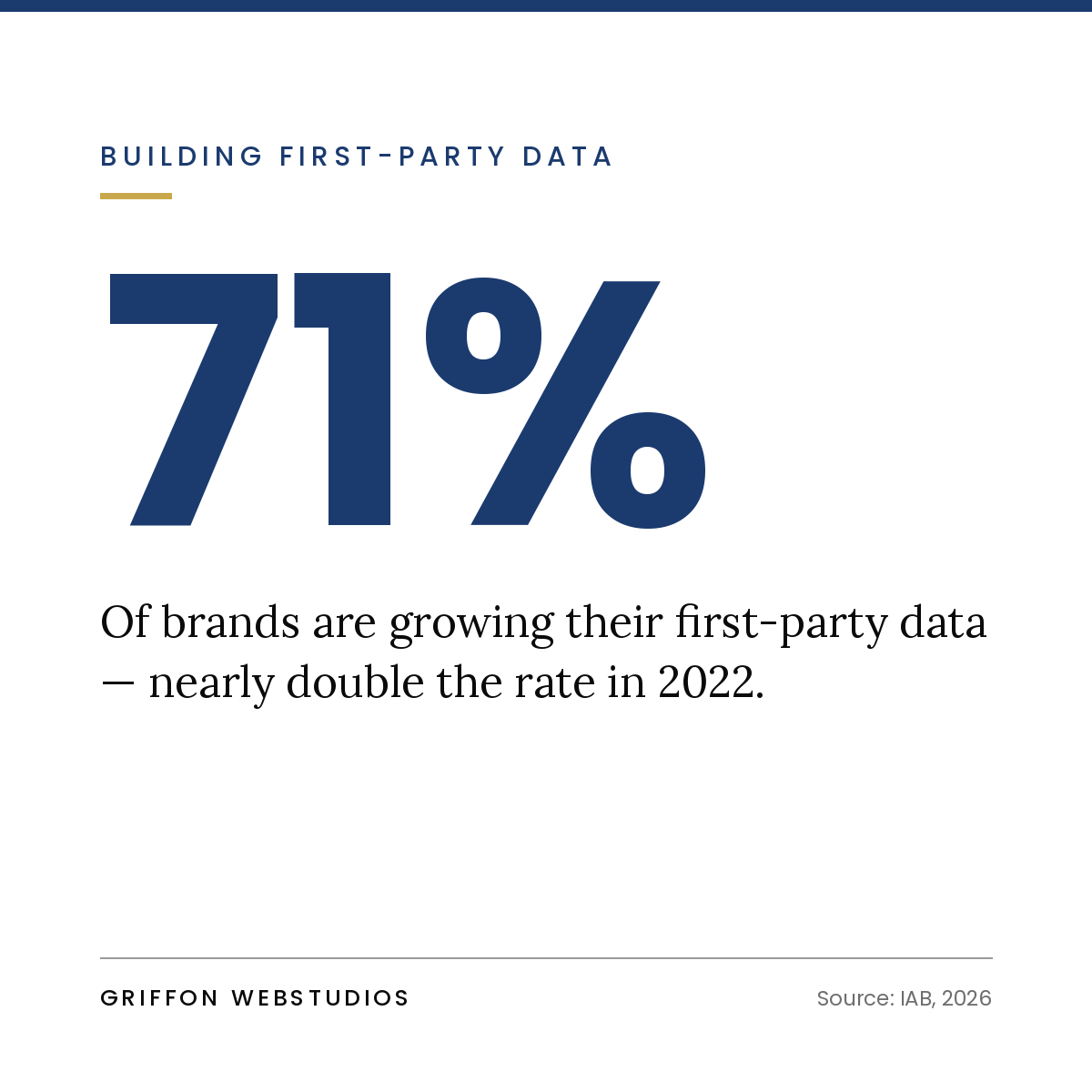
First-party data is information your prospects give you directly through forms, accounts, downloads, bookings, and your CRM. Unlike third-party cookies, it doesn’t depend on a browser’s permission to exist, and it’s far more durable and accurate. The firms that will measure clearly over the next few years are the ones building a deliberate first-party data foundation now: capturing the right information at the right moments and storing it where it connects to actual revenue.


2. Server-side tracking: move measurement off the browser
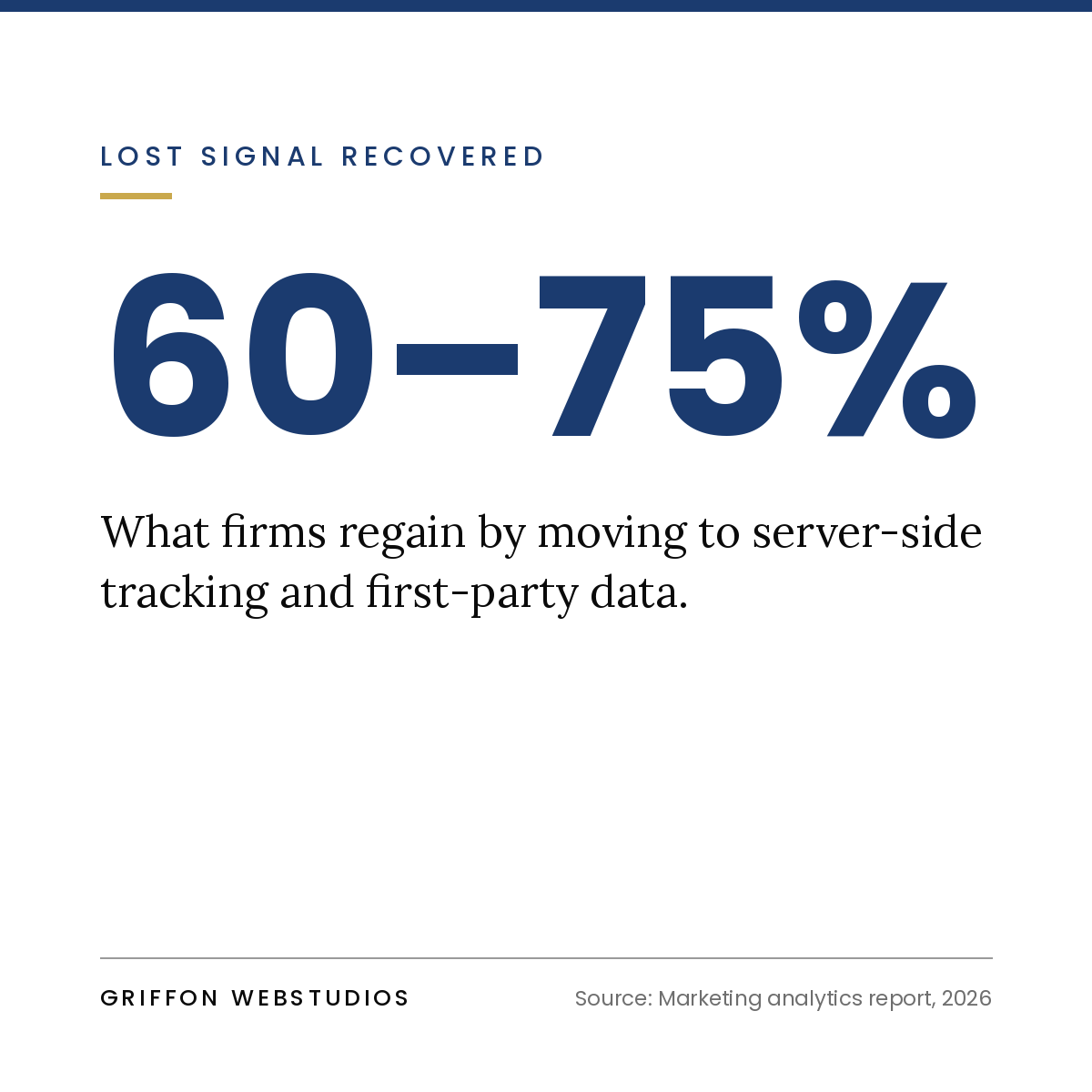
Most tracking still runs in the visitor’s browser, which is precisely where ad blockers, privacy settings, and browser restrictions intercept it. Server-side tracking moves that measurement to your own server, so the data is collected more reliably and you control what’s captured and shared. It’s more technical to set up, which is exactly why it’s become a real competitive edge for firms that bother to do it, and a permanent blind spot for those that don’t.

3. Consent done properly: you can’t measure what you didn’t earn

Privacy law and browser design now mean tracking and permission are inseparable. A sloppy consent banner doesn’t just create legal risk, it actively destroys your data, because every visitor who bounces off a bad prompt or silently opts out becomes a gap in your reporting. A well-designed consent experience, integrated with your tracking, is the difference between measuring most of your audience and measuring a frustrated fraction of it.

4. Self-reported attribution: just ask

The most underrated tool in the post-cookie era is a single question on your contact or booking form: “How did you hear about us?” For service firms with longer sales cycles and fewer, higher-value conversions, this human signal often beats any tracking pixel. It captures the dark-social referrals, the “I’ve followed you for a year” relationships, and the word-of-mouth that no script can see. Combined with your CRM, it turns soft impressions into a pattern you can actually read.

Why service firms need a different playbook than e-commerce

Most attribution advice is written for high-volume e-commerce, where thousands of transactions make statistical models reliable. Service firms operate in the opposite world: fewer leads, longer consideration periods, larger deal values, and trust built over months.

That changes the strategy. You don’t need to track every micro-interaction across a million sessions. You need to know which sources produce your best clients — not your most clicks — and you need a clean line from a lead’s first touch to the revenue it eventually generated. That means leaning hard on first-party data, self-reported attribution, and a CRM that captures the full journey, rather than chasing pixel-perfect tracking of anonymous traffic. For a service business, a connected CRM is the real analytics platform; the website and ad tools just feed it.

The mistakes that quietly cost you

A few patterns show up again and again when we audit firms’ measurement:

  • Trusting the dashboard’s defaults. Out-of-the-box analytics is built for the trackable average, not for a high-consideration service business. Defaults are where bad decisions begin.
  • Optimizing for the last click. Cutting the top-of-funnel channels that quietly create demand because a last-click report makes them look unprofitable. This is the most common and most expensive error.
  • Treating consent as a legal checkbox. A banner thrown up to satisfy a lawyer, with no thought to how it affects data capture, breaks your measurement and your compliance at the same time.
  • No connection between marketing and revenue. Tracking leads but never closing the loop on which leads became clients — so you optimize for cheap inquiries instead of profitable ones.
How to start

You don’t need to rebuild everything at once. A sensible sequence:

  1. Add self-reported attribution today. Put “How did you hear about us?” on every inquiry and booking form. It’s the fastest, cheapest signal you’ll get, and it starts working immediately.
  2. Make your CRM the source of truth. Ensure every lead’s source and journey is captured and tied to whether it became revenue. This is the foundation everything else reports into.
  3. Build a first-party data plan. Decide what you want to learn about prospects and design your forms, content, and capture points to gather it deliberately.
  4. Move tracking server-side. Get your core measurement off the browser so it survives privacy settings and ad blockers.
  5. Get consent right. Implement a consent experience that protects both compliance and data quality, rather than sacrificing one for the other.

Our thoughts

The post-cookie era didn’t arrive as a dramatic shutdown. It crept in while everyone waited for a deadline that kept moving. The firms still relying on default tracking aren’t getting a clear picture — they’re getting a confident-looking report built on a shrinking, biased sample, and steering real budget by it.

Knowing what’s actually working again isn’t about a smarter dashboard. It’s about owning your data: first-party information, server-side measurement, clean consent, and a CRM that connects marketing to money. Get that foundation right and your reporting stops being a guess dressed up as a number.


At Griffon Webstudios, we build that foundation — first-party data capture, server-side tracking, consent that protects your data instead of breaking it, and the CRM integrations that finally connect your marketing to your revenue. If your reporting feels more like a hunch than a fact, let’s take a look at your setup.


Why Your Analytics Are Wrong and What to Track Instead-1

Why Your Analytics Are Wrong and What to Track Instead

Most brands say they’re “data-driven,” but when you look at their dashboards, it becomes clear they’re tracking a whole lot of numbers and learning almost nothing. They review traffic, impressions, likes, and email open rates, then wonder why revenue doesn’t move.

The problem isn’t a lack of data. The problem is tracking the wrong data, in the wrong places, with no connection to business goals.

Let’s make this practical. Here are the metrics that actually predict growth, where to find them, which tools reveal what the native dashboards won’t, and how to use those numbers to set real targets.

1. Traffic Quality, Not Traffic Volume

Where brands go wrong: They chase more visitors instead of better visitors.

What to actually track: Session Quality + Intent Signals

Where to find it:

    • Google Analytics 4 → Explore → Session Quality
    • GA4 → Engagement → “Views per session,” “Engaged sessions,” “Event count per user”
    • Microsoft Clarity → Heatmaps + Scroll Depth
    • Hotjar → Session recordings

Why it matters: These tell you whether you’re attracting people who care or people who bounced in confusion. A spike in traffic means nothing if visitors don’t scroll, engage, or click.

How to set goals: Instead of “increase traffic by 20%,” set:

    • Lift “engaged sessions” from 42% → 55%
    • Increase average scroll depth to 60%
    • Improve homepage click-through rate (CTR) on primary CTA by 15%

These metrics tell you whether the right users are landing and moving.

2. Source-Level Conversion Rate (Not the Overall One)

Where brands go wrong: They quote a single conversion rate, a number so blended it’s useless.

What to track: Conversion rate by source/campaign/landing page/device.

Where to find it:

    • GA4 → Reports → Traffic acquisition
    • GA4 → Advertising → Conversion Paths
    • Shopify → Analytics → Sales by traffic source
    • Meta Ads → Breakdown → “By Placement,” “By Age,” “By Time”
    • Google Ads → Segments → Device
    • Triple Whale or Northbeam for attribution clarity

Why it matters: You might think Meta ads “aren’t working,” when in reality one audience segment has a 9% conversion rate and everything else is dragging the average down or a page performs well on desktop but fails on mobile.

Goal-setting example: Instead of “increase conversion rate,” define:

    • Pause all ad sets under 1%
    • Scale only sources with CAC < LTV/3
    • Lift mobile conversion from 0.8% to 1.5%
    • Improve one specific landing page from 2% → 3.2%

3. Customer Acquisition Cost (CAC) Relative to Lifetime Value (LTV)

Where brands go wrong: They try to lower CAC without understanding if it even needs to be low.

What to track:

    • CAC per channel
    • LTV by segment (new customers vs repeat)
    • Payback period (how long before you break even)

Tools that reveal this:

    • Shopify + Lifetimely (LTV calculator)
    • Triple Whale (LTV, MER, blended CAC)
    • Klaviyo → Cohorts
    • Google Analytics → Predictive Metrics (2024+ rollout)

Why it matters:

If your CAC is $50 and your LTV is $400, your CAC isn’t a problem, your scale is.

If CAC is $30 and LTV is $45, your business model is the problem, not the ads.

Goals that actually matter:

    • Maintain CAC:LTV ratio of 1:3
    • Extend retention window from 45 → 90 days
    • Reduce payback period from 60 → 30 days

These are the kinds of numbers you plan a business around.

4. Return Purchase Rate and Repeat Behavior

Where brands go wrong: They obsess over new customers and ignore retention.

What to track:

    • 30-day repeat purchase rate
    • 60-day repurchase rate
    • Product affinity (what people buy next)

Where to find it:

    • Shopify → Analytics → Cohorts
    • Klaviyo → Cohort Analysis + Flow Performance
    • Peel Insights, Glew, or Repeat for deeper retention insights

Why it matters: Your best customers are the ones who come back. They stabilize cash flow and make ad spend tolerable.

Practical goal:

    • Lift 30-day repeat rate from 12% → 18%
    • Create a post-purchase flow aimed at the second purchase
    • Identify the product with the highest lifetime value impact and promote it earlier

Companies using behavior-driven analytics improve conversion rates by 20–40%.

5. Assisted Conversions

Where brands go wrong: They judge channels as if they operate in silos.

What to track: Which touchpoints influence the conversion even if they don’t close it.

Where to find it:

    • GA4 → Advertising → Conversion Paths
    • Northbeam → Path Analysis
    • Triple Whale → Journey
    • HubSpot CRM → Contact Activity + Deal Attribution

Why it matters: Most buyers don’t convert on the first touch. When you kill channels that “don’t convert,” you often kill the channels that actually create demand.

How to set goals:

    • Identify channels with strong assist value
    • Increase content-driven assists by 20% (blogs, emails, reels, YouTube)
    • Adjust budgets so awareness channels aren’t starved

This is how you stop underfunding the work that drives long-term ROI.

6. Engagement Depth, Not “Time on Page”

Where brands go wrong: They think staying longer means caring more.

What to track:

    • Scroll depth
    • Element interaction
    • Product exploration
    • Form start → submission rate

Where to find it:

    • Microsoft Clarity
    • Hotjar
    • GA4 → Events → “scroll,” “click,” and “view_item_list”

Why it matters:

    • Two minutes on a page could mean “I’m interested,” or “I’m lost.”
    • Scroll and interaction tell the truth.

Goal-setting example:

    • Increase product page scroll to 75%
    • Improve form completion from 22% → 35%
    • Raise PDP interaction events (zoom, variant change, add to cart) by 20%

7. Revenue per Visitor (RPV)

If you want one number that tells you whether your marketing, product, pricing, and UX are working together, it’s this.

Where to find:

    • Shopify → Online Store Sessions → RPV
    • GA4 → Monetization → Overview
    • Elevar or Littledata → Enriched GA4 data

Why it matters:

    • RPV combines conversion rate + average order value.
    • When this number rises, everything is aligned.

Goal: Increase RPV by 15% through price testing, bundling, UX tweaks, and higher-quality traffic.

Analytics Should Drive Decisions

The real purpose of analytics isn’t to generate prettier reports, it’s to give you direction. Most brands get lost because they chase surface-level numbers, rely on incomplete platform dashboards, or misinterpret data without understanding the behavior behind it.

Real growth comes from identifying the right metrics, using reliable tools, and setting goals grounded in how customers actually move through your funnel. When you focus on that, everything starts to align, decisions become clearer, budgets get smarter, and your marketing stops feeling like guesswork.

At Griffon Webstudios, we help brands cut through the noise, uncover the signals that matter, and turn their analytics into a system that consistently drives revenue, not just reports.


Why Every Business Needs a First-Party Data Strategy

Why Every Business Needs a First-Party Data Strategy

The marketing world is about to change in a way most businesses still underestimate. Cookies are disappearing, tracking is tightening, and ad platforms are becoming black boxes that give you less visibility every year. By 2026, you won’t just be dealing with a more private internet, you’ll be dealing with a landscape where brands that don’t control their own data will be at a severe disadvantage.

What this really means is simple: if you’re not building a first-party data strategy now, you’ll feel its impact in the form of weaker targeting, higher ad costs, poor personalization, and confused reporting.

Let’s break down why this shift matters and what smart brands should be doing right now.

The Era of Easy Tracking Is Over

For more than a decade, marketers lived off third-party data. You could drop a pixel, track users across multiple sites, build lookalike audiences, and target people with a level of precision that felt almost unfair.

That era is gone.

Browsers are blocking tracking. iOS has shut down cross-app data without explicit permission. Google’s phaseout of third-party cookies is well underway. Regulations are tightening. In short, all the “easy” data, the data you didn’t own is evaporating.

Once that disappears, the brands that still thrive will be the ones that built their own intelligence instead of renting it from someone else.

First-party data is the only source you truly control

First-party data is anything a customer share with you directly. It could be email addresses, purchase history, chat conversations, survey responses, loyalty activity, website behavior, and even the content they engage with.

Companies using first-party data for key functions see up to 2.9x revenue 

This is the most reliable, permission-based information you can get. No browser update can take it away. No ad platform can restrict it. And because it comes straight from your audience, it’s far more accurate than anything stitched together through third-party tracking. Businesses that treat first-party data like a competitive asset will win on three fronts: targeting, personalization, and retention.

Targeting gets sharper even when the ecosystem gets blurrier

The truth is, ad platforms aren’t losing data entirely, you are. Meta, Google, and TikTok still rely on massive datasets, but they’re giving you less visibility into how things really work. Algorithms are becoming more automated, opaquer, and more dependent on the inputs you provide.

That’s the key.

First-party data becomes your strongest signal, telling these platforms who your real customers are so they can optimize toward people who behave like them. If you feed Meta weak signals, your campaigns wander.

If you feed it strong customer lists, segmented by value, behavior, and intent, your cost per result drops. By 2026, successful brands will be the ones that treat their data collection like an ongoing growth engine, not an afterthought.

Personalization stops being a luxury and becomes expected

Consumers already expect digital experiences to adjust to them. They don’t want to be treated like strangers. They don’t want generic recommendations. They don’t want ads that feel random. And they certainly don’t want to repeat information they’ve already shared.

First-party data allows you to build experiences that adapt in real time:

    • Showing products based on past browsing
    • Tailoring email flows to buying habits
    • Offering personalized landing pages
    • Building custom loyalty rewards
    • Creating content sequences based on user intent

This level of relevance used to be a competitive advantage. Now it’s the minimum standard. The brands that can’t personalize will feel outdated, slow, and disconnected.

Retention Becomes Cheaper Than Acquisition

Acquisition costs are rising. Competition is rising. Algorithms are less predictable. So the brands that grow in the next few years will double down on retention and it depends heavily on how well you understand your customers.

First-party data gives you insight into:

    • Why customers return
    • What triggers repeat purchases
    • What signals churn
    • What segments are the most profitable
    • Which messages convert best

When you understand these patterns, your retention strategy stops being guesswork. You get ahead of churn. You increase lifetime value. And your ad spend stretches further because you’re not constantly scrambling for new buyers.

So what does a real first-party data strategy look like?

It’s not one tool. It’s not a pop-up. It’s not buying another dashboard. It’s a system built on four pillars:

1. Collection

You need frictionless ways to gather data through:

    • email captures
    • quiz funnels
    • post-purchase forms
    • loyalty programs
    • gated content
    • conversational chat flows

The key is simple: customers will share data if the value is obvious.

2. Organization

A spreadsheet won’t cut it. You need a CRM or CDP that unifies behavior across channels so you can actually use what you collect. When your email data, ad data, web analytics, and purchase data finally live together, you stop operating blind.

3. Activation

This is where the magic happens. You push structured data back into your marketing stack so your campaigns can adapt automatically. You build segments based on real behavior, not assumptions. You let your site personalize itself. You let your emails adjust to intent.

4. Protection

If customers give you data, you have to earn their trust. Clear permissions, secure storage, and transparent communication matter more than ever. Privacy isn’t a burden, it’s part of your brand perception now.

Personalized ads, powered by first-party data, help businesses exceed revenue targets (54% of executives).

The window is closing

Brands that keep waiting will be reacting from behind while the prepared ones will already be operating with cleaner data, smarter automations, and sharper audience insights. The shift isn’t theoretical anymore; it’s happening right now. User expectations have changed. Privacy rules have tightened. Platforms are giving you less visibility, not more.

The tools exist. The opportunity is here. The only variable is whether a business moves early enough to benefit from it.

A first-party data strategy isn’t a nice upgrade; it’s the foundation of future-proof marketing. The companies that build this system now will dominate the next decade of digital performance, and the ones that delay will spend years trying to catch up.

At Griffon Webstudios, this is exactly the kind of groundwork we help brands put in place, not just to survive the new landscape, but to grow in it with confidence, clarity, and control