
Shoppers do not make decisions the way store owners assume they do. Here is what behavioral science actually says about online buying, and the line between persuasion and the practices regulators now prosecute.


Shoppers do not make decisions the way store owners assume they do. Here is what behavioral science actually says about online buying, and the line between persuasion and the practices regulators now prosecute.
Ask a business owner about site speed and you get a shrug. Ask them about losing half their prospects before the page finishes loading and you get a different conversation. Those are the same conversation. Core Web Vitals is the name Google gave to a set of measurements, and because it sounds technical, it lands on a developer’s task list and stays there, competing with features that feel more urgent. The framing is the problem. These are not developer metrics. They are a measurement of how many people give up on your business before they have seen anything you offer.
This article is about the money, not the code. What the metrics actually measure, what the evidence says they are worth, how to work out the cost for your own business, and how to decide whether fixing it is worth what it costs.
Google measures three things about the experience of a real visitor loading a real page.
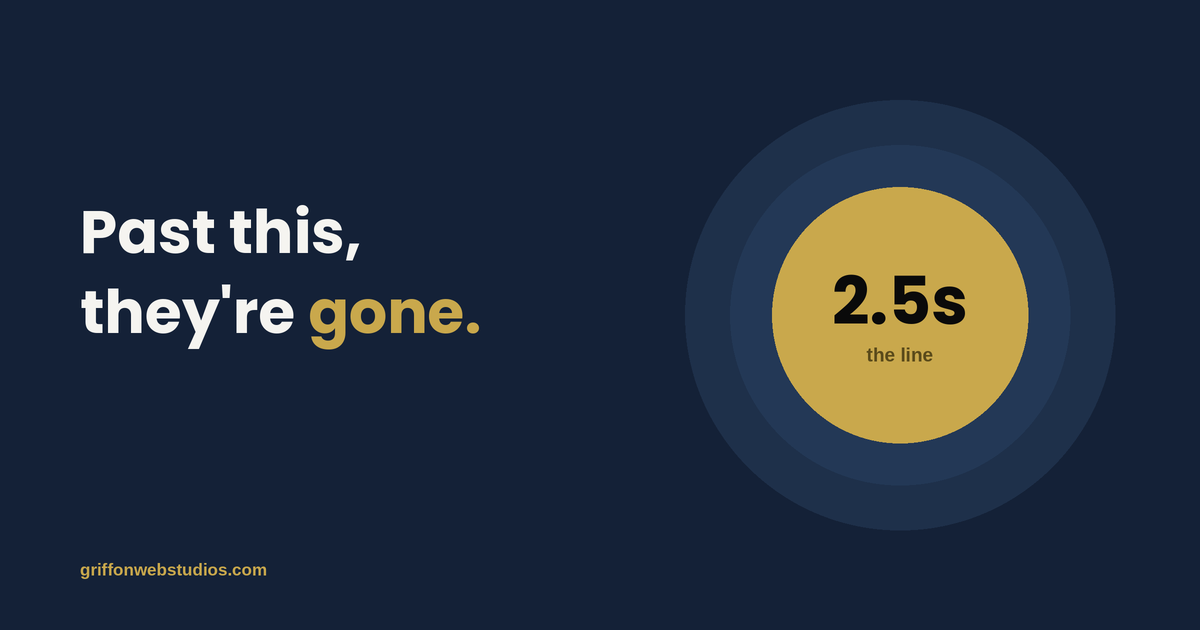
Speed: The first is how long it takes for the main content to appear. Not the first pixel, not a spinner, but the thing the visitor actually came to see: the headline, the hero image, the product. Google calls this Largest Contentful Paint, and the threshold for a good experience is 2.5 seconds.
Engagement: The second is how quickly the page responds when someone interacts with it. They tap a button, open a menu, start typing, and the page either reacts immediately or sits there. Google calls this Interaction to Next Paint, and the threshold is 200 milliseconds. This one replaced an older responsiveness metric, and plenty of sites that comfortably passed the old one fail this one, because it measures the full interaction rather than just the first moment of it.
User Experience: The third is whether the page holds still. Content loads in stages, and if a late-arriving image or ad shoves everything down the screen, the visitor loses their place or taps the wrong thing. Google calls this Cumulative Layout Shift, and the threshold is 0.1.
Two details matter for interpreting your own numbers. Google grades you at the 75th percentile, meaning three quarters of your visits must meet the threshold, so a good average can still be a failing grade. And it grades on field data collected from actual Chrome users rather than on a test you run yourself, which is why a flattering score in a speed testing tool can coexist with a failing assessment. Your visitors’ phones and networks are the measurement, not your office wifi.
The most reliable numbers come from businesses that ran controlled tests rather than from vendors selling optimization. Google maintains a collection of these, and the pattern across them is consistent enough to be useful even though the magnitudes vary wildly by industry.
Rakuten’s Japanese storefront ran an A/B test between an optimized landing page and the original, identical in every other respect, and reported a 53.37% increase in revenue per visitor and a 33.13% increase in conversion rate on the optimized version. That is a large number from a large site, and no small business should expect to replicate it. What travels is the direction and the mechanism, not the multiple.
Google’s own collection of business impact case studies shows the same shape repeatedly across different industries: measurable improvements in conversion, engagement, and revenue following performance work. Notably, several report gains in the low single digits to low double digits rather than in the fifties, which is the more realistic expectation for most businesses.
Two things are worth being careful about here. Numbers in this space get inflated and repeated without sourcing, and a meaningful share of what circulates traces back to studies on enormous ecommerce sites where a fractional percentage is worth millions. Correlation is also doing some work in these studies: faster sites often belong to companies that invest more in everything, so not all of the gain is attributable to speed alone. The honest version of the claim is that performance improvements reliably move conversion in the right direction, that the effect is larger on mobile and on ecommerce than elsewhere, and that anyone promising you a specific percentage before looking at your site is guessing.
You do not need industry benchmarks to price this. You need four numbers you already have.
Take your monthly visitors, your current conversion rate, your average value per conversion, and your close rate if you sell a service rather than a product. That gives you the revenue your site produces now. Then model a conservative improvement, say a one to two percentage point lift in conversion rate rather than a fifty percent one, and rerun the arithmetic. The difference is your annual opportunity, and for most businesses it is dramatically larger than the cost of the work.
For example, A service business gets 5,000 monthly visitors, converts 2% into inquiries, closes a third of those, and averages $3,000 per job. That is 100 inquiries, about 33 jobs, roughly $99,000 in monthly revenue. Move the conversion rate to 3%, which is a plausible outcome of removing real friction rather than an aggressive one, and you get 150 inquiries, 50 jobs, and about $150,000. The gap is meaningful, it recurs every month, and it exists whether or not anyone ever fixes it.
Run this with your own numbers before you commission any work. It tells you both whether the project is worth doing and how much it is rationally worth paying for.
Most of your traffic is on a phone, on a cellular connection, often on a device several years old. Your website looks fast to you because you are testing it on good hardware and a fast connection, frequently with the page already cached. That experience is not representative of anyone else’s.
This is also where the gap between test scores and reality opens up. A testing tool runs a simulation on a specified connection and gives you a lab score. Google’s assessment uses field data from real Chrome users on real devices. When those two disagree, the field data is the one that describes your customers. A green score in a speed test and a failing Core Web Vitals assessment can be true simultaneously, and if you only ever look at the score, you will conclude the problem is solved when it is not.
Google has said clearly that page experience is a ranking consideration and equally clearly that it is not a dominant one. Content relevance and quality matter far more. The practical read is that Core Web Vitals behaves like a tiebreaker: when two pages are otherwise comparable, the better experience has an edge.
That should change how you value the work but not whether you do it. If you are pursuing performance purely for rankings, you are chasing the smaller of the two prizes and you will probably be disappointed. The conversion effect on the visitors you already have is the larger and more immediate return, and it arrives in days rather than the months a ranking shift would take. Search visibility and on-site conversion are different jobs, and performance work pays into the second one first.
Most slow sites are slow for a short list of reasons, and none of them are exotic.
Oversized images are the most common single cause, particularly on WordPress sites where full-resolution uploads get displayed at a fraction of their size. Modern formats and correct sizing frequently solve the largest share of the problem on their own.
Plugin and script accumulation is the second. Every tracking tag, chat widget, popup tool, and abandoned plugin costs something on every page load, and almost nobody audits what is still installed. Third-party scripts are also the usual culprit behind poor interaction responsiveness, because they occupy the browser precisely when a visitor is trying to do something.
Cheap hosting shows up as slow server response, which delays everything downstream no matter how well the rest of the page is built.
Heavy themes and page builders load large amounts of code for features a given page never uses.
And layout instability almost always comes from images, ads, or embeds that arrive without reserved space, plus web fonts that swap in late and reflow the text.
The order matters. Images and hosting usually deliver the largest gains for the least money, and it is worth exhausting the cheap fixes before anyone proposes a rebuild.
The decision is a straightforward comparison once you have run your own numbers. Compare the annual revenue opportunity from a conservative conversion improvement against the cost of the work. For most small and mid-sized businesses, image optimization, a plugin audit, and better hosting land well under the value of a handful of additional jobs a year.
Two cautions. Diminishing returns are real: getting from awful to good is where the money is, and getting from good to perfect is usually a poor use of budget. And if you are planning a redesign anyway, handle performance as part of that project rather than paying twice, because a redesign is also the moment performance most often regresses when a heavier theme ships without anyone checking.
Core Web Vitals is not a technical scorecard to satisfy Google. It is a measurement of how many people your website loses before it has a chance to sell anything, and it has a dollar value you can calculate from numbers already sitting in your analytics. Calculate it. If it is small, deprioritize the work honestly. If it is large, you now know what you are losing every month you leave it alone.

“Time on site” is a vanity metric that confuses engagement with confusion. Here is what design actually does to move a visitor from landing to converting, and the handful of elements that decide whether they stay long enough to.
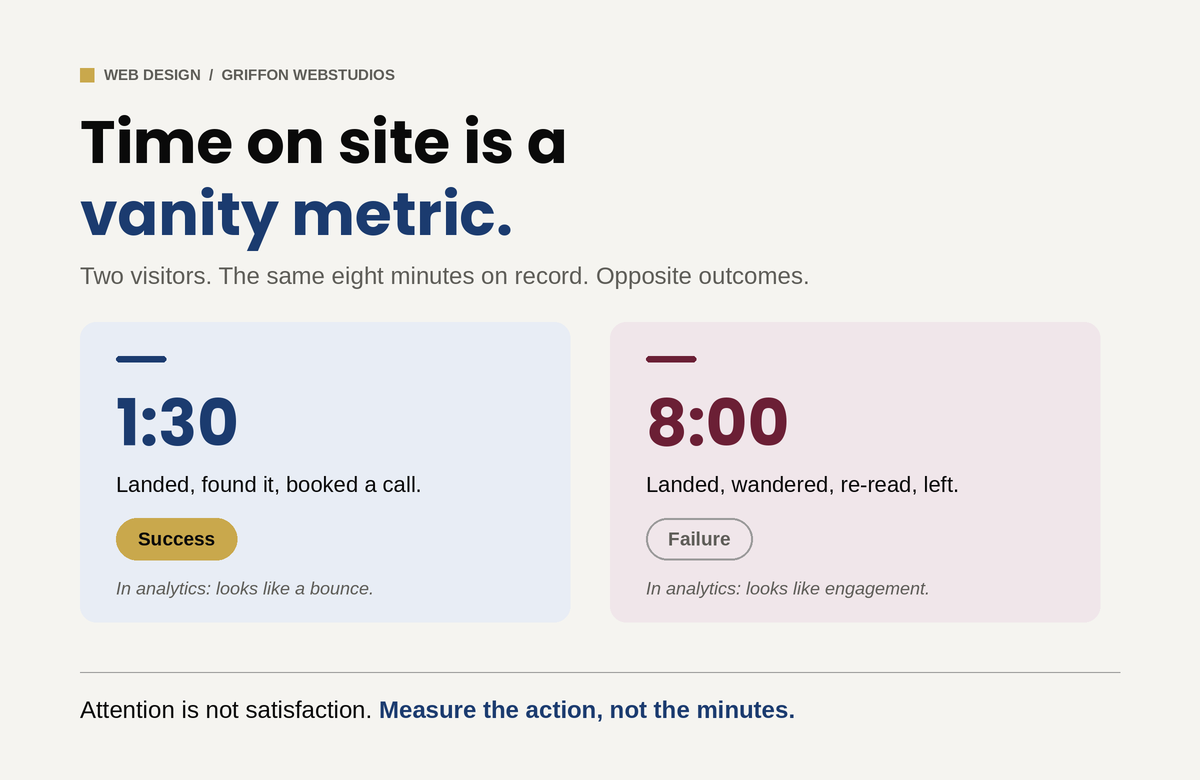
“How do we keep people on the site longer?” is one of the most common questions a business owner asks about their website, and it is the wrong one. A visitor who lands, instantly finds what they came for, and books a call in ninety seconds is a triumph, and in your analytics their short session looks almost identical to a bounce. Meanwhile, a visitor wandering your site for eight minutes, clicking back and forth, re-reading the same page because they cannot find what they need, racks up the engagement numbers everyone celebrates and then leaves without doing anything. Time on site measures attention. It does not tell you whether that attention was satisfaction or confusion, and for most business websites those are opposite outcomes.
The goal of design is not to detain people. It is to move them: to confirm in seconds that they are in the right place, build enough trust to act, and remove every reason to leave before they convert. The visitors who “stay” in the way that matters stay because the design earned it, not because it trapped them. Here is what actually does that work.
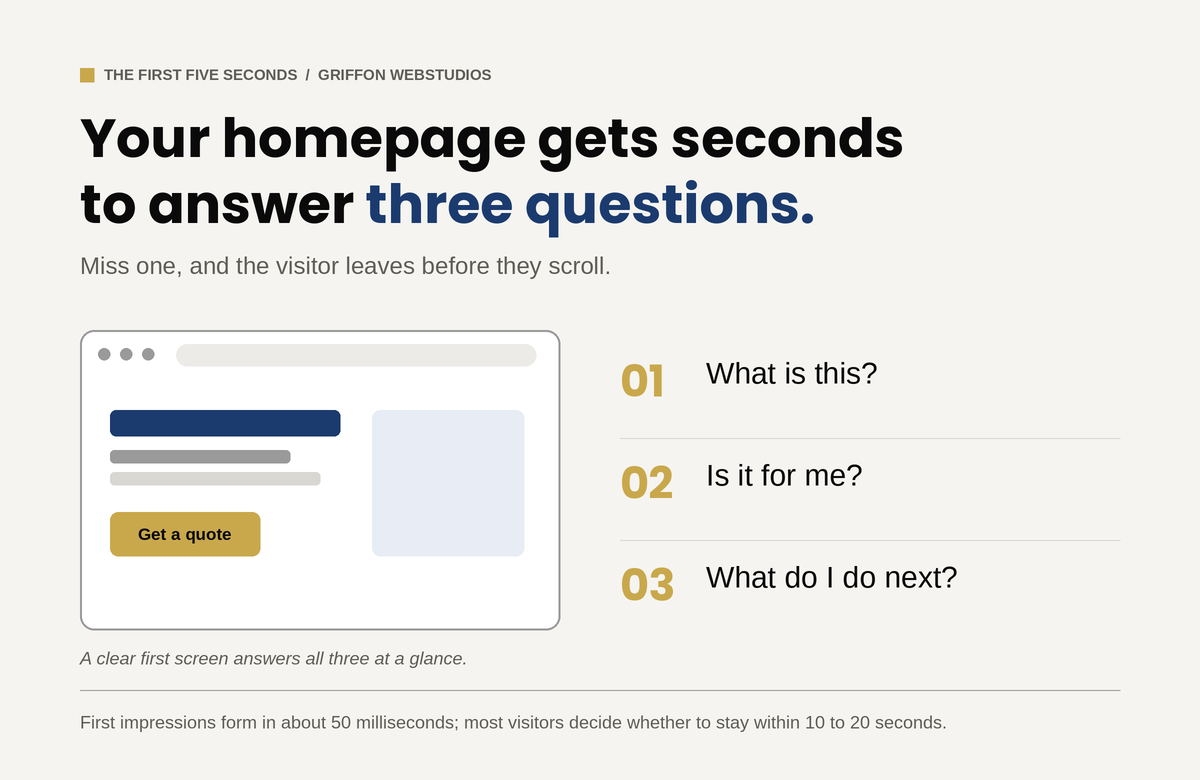
A visitor forms an impression of your site in well under a second. Research summarized by the Nielsen Norman Group puts the first visual judgment at roughly 50 milliseconds, and NN/g’s own behavioral data shows that users routinely leave a page within 10 to 20 seconds unless something gives them a reason to stay. In that window they are answering three questions, fast and mostly subconsciously: What is this? Is it for me? What do I do next? If your homepage’s first screen does not answer all three, they leave, not because the rest of the site is bad, but because they never got a reason to scroll to it.
This is where clever loses to clear. A hero section with a vague slogan and a stock photo of people pointing at a laptop answers none of the three questions. A hero that states plainly what you do, who it is for, and what to do about it answers all three before the visitor has to think. The single highest-leverage design decision on most websites is not a color or a font. It is whether the first screen confirms relevance instantly. Everything downstream depends on the visitor getting past it.
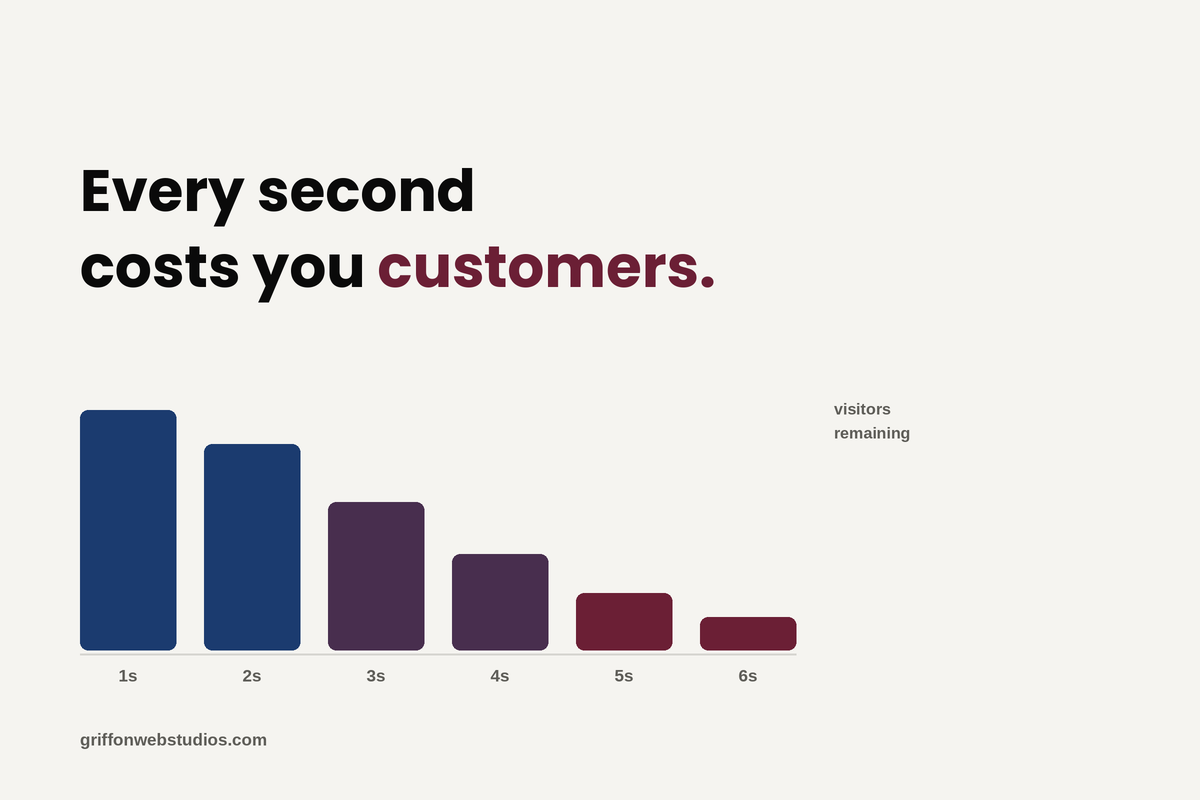
Before a visitor can judge your design, the design has to load. Google’s research found that as page load time climbs from one second to three, the probability of a bounce rises by 32%, and that 53% of mobile visitors abandon a page that takes longer than three seconds. The ones who leave do so before they have seen a single thing you built. You can have the best-designed site in your market and lose most of its visitors to a delay they never forgave. Google’s own Core Web Vitals thresholds put the target for loading the main content at under 2.5 seconds.
But raw speed is only half of it. Perceived performance, meaning how fast the site feels, matters as much as the number on a speed test. A page that renders its above-the-fold content first feels instant even while the rest loads. A page where content jumps around as images and ads load in feels broken, and visitors do not trust broken. That specific problem has a name and a metric: Cumulative Layout Shift, one of the signals Google uses to score visual stability. Layout stability, progressive loading, and rendering what matters first are design and engineering decisions that directly determine whether anyone stays long enough to engage at all.
Engagement is not decoration. It is whether the design tells a visitor where to look and what to do next. The human eye scans a page in predictable patterns, and good design works with them: the most important thing is the most visually prominent thing, contrast pulls attention to the action you want, and whitespace gives the eye somewhere to rest instead of drowning it.
The enemy here is equal weight. A page with ten things shouting at once (five calls to action, three pop-ups, a slider, a chat bubble) gives the visitor no idea what matters, and a visitor who cannot tell what matters does nothing. More options slow people down, and more competing elements dilute each other until none of them win. One clear primary action per screen, supported by a hierarchy that makes the path obvious, moves people. Clutter freezes them.
Each form field you ask for, each decision you force, each ambiguous label is a small tax on the visitor’s effort and patience. The more choices and the more steps, the slower and less likely the action. Research from the Baymard Institute found that what actually drives form abandonment is not the number of steps but the number of fields: the average checkout asks for around 12 form fields when 7 or 8 would do, and trimming the excess measurably lifts completion. The same logic applies to any form on any site. A contact form with twelve fields converts worse than one with three, not because the visitor could not fill out twelve, but because each field is another moment to reconsider whether it is worth it.
The design that keeps people engaged is the one that asks the least of them. This is partly about respecting the visitor’s cognitive load: every extra element to process is mental effort, and mental effort is what makes people quit. Strip the form to what you actually need. Defer the complex stuff until after the visitor is committed. Make labels unambiguous so nobody has to guess. The instinct to add (another field, another step, another option) is almost always the wrong one. Subtraction is the underrated design skill.
For a business website, the thing that keeps a visitor from leaving usually is not an animation or a clever interaction. It is whether they believe you. Visitors abandon sites that feel untrustworthy faster than they abandon sites that are merely plain, and design communicates trust before a word is read. Real photos instead of stock, visible reviews and credentials, clear and present contact information, and professional polish all act as proxies for competence: the visitor cannot evaluate your work directly, so they judge the signals around it.
This is why a clean, credible, slightly plain site routinely outperforms a flashy one that feels off. The flash raises a question the visitor cannot quite articulate: can I trust these people with my money? Design that answers yes, through evidence and polish rather than spectacle, is what keeps a serious buyer on the page long enough to act.
More than half of all web traffic is now mobile, and a design that engages on a desktop monitor and falls apart on a small screen loses the majority of its visitors. Tap targets too small to hit, text that requires zooming, a primary call to action stranded where a thumb cannot reach, a layout that scrolls sideways: each of these is an exit. The engagement question is a mobile question first and a desktop question second. Designing for the big screen and hoping the phone version survives is designing for the minority of your traffic.
If time on site is the wrong metric, what is the right one? The path, not the duration. Did the visitor scroll far enough to see what matters, which scroll depth tells you. Did they move toward the action, which the conversion path tells you. Did they come back and search again, which is the quiet signal that they did not find what they came for the first time. Getting the right visitors to the page is the job of search visibility; turning them into customers once they arrive is the job of design, and the two require different work.
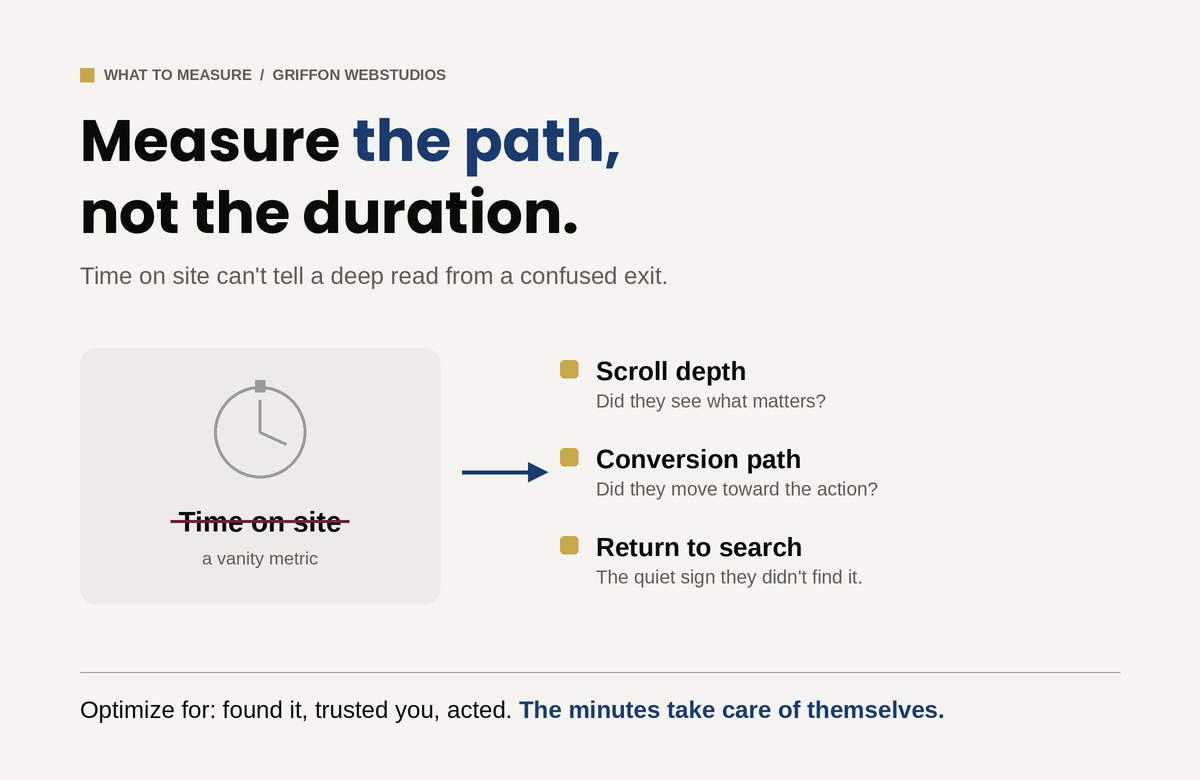
A visitor reading deeply because your content is genuinely engaging and a visitor clicking around lost because your design is confusing can produce nearly identical time-on-site numbers. The first is success and the second is failure, and only by watching where attention goes, and whether it ends in an action, can you tell them apart. This is the same trap that catches businesses chasing raw traffic: more visitors rarely fix a problem that lives between the click and the contract. Optimize for the visitor finding what they came for, trusting you, and acting. The minutes take care of themselves.
“How do we keep people on the site longer?” assumes attention is the goal. It is not. Attention is the cost a visitor pays to find out whether you can help them, and the best design spends as little of it as possible before delivering the answer and the next step. If your traffic is healthy but your site is not converting, the fix is rarely more visitors and almost always a website built to convert. And if the traffic itself has fallen, that is a separate diagnosis entirely. Stop trying to hold people. Earn the action that matters, remove every reason to leave before it, and the visitors worth keeping will stay exactly as long as they need to.
For years, marketing followed a familiar pattern. Run a campaign, see a spike, measure the results, then repeat. It worked, but it was always a cycle of building up and tearing down.
By 2025, many of the strategies that used to work just weren’t delivering. Attention spans kept shrinking, results were harder to sustain, and the old playbook started to fall short. Instead of relying on big, noisy campaigns, the shift moved toward being present all the time, quietly, but consistently.
The transition occurred without any prior indication that it would. It just happened.
There were fewer channels, decisions took longer, and it was easier to see what worked. If you had a strong idea and enough budget, you could own the moment.
That environment is gone now.
Today, customers find brands in all kinds of places- search results, AI summaries, social feeds, reviews, emails, and recommendations. By the time they see a promotion, they may have already made up their mind.
Campaigns haven’t stopped working. They’ve just lost their monopoly on influence.
Here’s the thing: always-on marketing is often misunderstood. It’s not about churning out endless posts, ads, or emails. That just burns out your team and makes your message less effective.
Real always-on marketing works quietly, in the background.
The key point here is to show up consistently in the right places when customers are looking for answers, whether that’s through search, AI tools, social media, or direct contact. You don’t need to be everywhere, just where it matters.
Now, it’s more about staying focused than pushing hard.
Campaigns assume everyone is paying attention at once. That’s rarely true anymore. Buying journeys are unpredictable and spread out over time.
People learn in fragments:
If you only show up during campaigns, you risk disappearing in between. Always-on presence keeps you connected with customers throughout their journey, building trust that lasts beyond a quick sale.
The main benefit of continuous marketing is steady results instead of big spikes. It’s about building up over time.
Small, consistent signals help people get familiar with your brand. When people know you, decisions come easier. The brand becomes an easy choice, even if customers can’t explain exactly why.
Always-on strategies may seem slow at first, but over time, they deliver better results than campaigns. They build lasting memories, not just numbers.
This doesn’t mean performance marketing is obsolete. It means performance relies more heavily on groundwork.
Paid campaigns convert better when:
Without this foundation, campaigns have to work harder for less. With it, performance improves even as budgets stay steady.
Always-on marketing doesn’t replace campaigns. Instead, it helps the whole system work better.
People find the transition hard because they measure results differently. Campaigns are easy to track, but always-on influence is harder to spot since it’s always running.
Brands that focus only on short-term metrics miss the real improvements happening in their business.
You’ll notice the effects as steady progress, not sudden jumps.
It is easy to focus on the next campaign launch. However, consider what occurs when someone encounters your brand unexpectedly.
Inconsistency across campaigns creates gaps in marketing efforts, leading to confusion and missed opportunities. The key is to remain focused. Avoid producing unnecessary content.
Many brands are now bringing together marketing, UX, content, and data
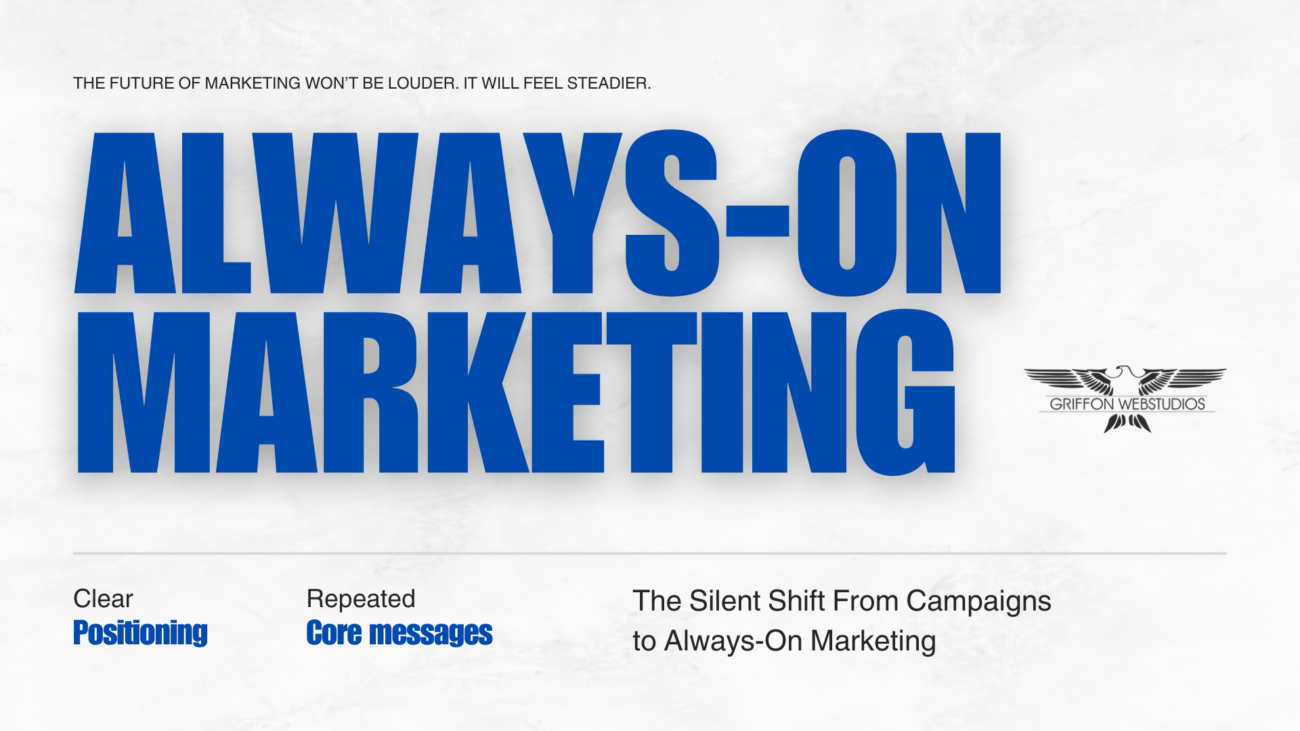
The future of marketing won’t be louder. It will feel steadier. Brands that adapt will see more sustainable growth. They’ll reach customers who are getting harder to find.

Technology has given marketers incredible power. We can reach the right person, at the right time, with the right message without lifting a finger. Our dashboards hum with automation. Our campaigns adjust themselves. Our ads learn faster than we can.
And yet, in all this progress, something fragile hangs in the balance: TRUST.
Because while automation can make marketing faster, it can also make it feel colder. The very systems designed to connect us can, if left unchecked, strip away the human warmth that makes a brand worth believing in.
Automation is intoxicating. It delivers the three words every marketer loves (precision, efficiency, and scale). You can run complex workflows, trigger personalized emails, predict what customers want before they ask.
But here’s the problem: AUTOMATION DOESN’T UNDERSTAND EMPATHY.
It doesn’t know the difference between persuasion and pressure. It doesn’t sense when a person’s “abandoned cart” is a moment of hesitation, not an invitation to flood their inbox. It doesn’t always realize when personalization crosses the line into intrusion. The technology does exactly what we tell it to do and sometimes that’s the issue.
When algorithms become the voice of a brand, we risk losing what makes people trust us in the first place: authenticity.
Ethical marketing isn’t about being “nice.” It’s about being human in a world increasingly run by machines.
It’s asking tough questions before automating an experience.
Ethical marketing is built on four simple principles:
When brands live by these rules, they don’t just avoid backlash, they earn loyalty.
Ethics shouldn’t be an afterthought; it should be part of the product design. Imagine automation that’s not just smart but self-aware:
When brands design systems with respect at their core, users can feel it. The experience changes. Suddenly the interaction feels less like marketing and more like a conversation.
Here’s the truth: technology can imitate empathy, but it can’t feel it. That’s why the human layer as the strategist, the storyteller, the customer-support rep is still irreplaceable. People don’t want perfection; they want to feel seen. They want to know that behind every smart algorithm, there’s a smarter human who cares about their experience.
75 % of Americans believe businesses committed to ethical marketing practices are more likely to be successful long-term- WSU.
A kind tone in a message. A real person’s name on an email. A brand that admits when it makes a mistake. Those things matter more than the most sophisticated funnel. Because automation might win the click but empathy wins the customer.
As technology gets sharper, the brands that stand out won’t be the ones with the most AI-driven marketing engines. They’ll be the ones people trust. The ones who automate thoughtfully. Who personalize without invading. Who remember that data points are people and people deserve dignity.
Automation is a gift, but it’s one that demands restraint. Ethics isn’t the opposite of performance; it’s the foundation of lasting performance. When we use technology to enhance connection instead of replacing it, marketing becomes a bridge between human needs and human creativity.
And in a world obsessed with speed, maybe the most radical thing a brand can do is simply slow down and remember the person on the other side of the screen.
Websites used to have a static content before the advent of modern tech. Every visitor saw the same homepage, call-to-action, and the same user journey. Today, that approach feels outdated. Customers expect brands to recognize their preferences, anticipate their needs, and deliver tailored experiences.
The future of digital design will be influenced by website personalization which serves as the solution to this problem.
89% of digital businesses are investing in personalization. (Forrester)
Website personalization means adapting the content, layout, and interactions of a site based on who the user is and what they’re likely looking for. The digital version of a salesperson functions as a system which remembers your name and previous buys to suggest products that match your preferences.
Your website can now function as a dynamic system which provides customized offers and messages and pathways to users in real-time.
The digital world presents people with strong competition while their ability to focus remains short. If your site doesn’t speak directly to the visitor, they’re gone in seconds. Personalization delivers three fundamental advantages to users.
In short, personalization turns passive browsers into active participants.
Modern web design has the tools to deliver this at scale. The following personalization methods are widely used:
Location Based: Delivers content based on location by displaying different offers to visitors who are in New York vs Los Angeles.
Behavior Driven: Product recommendations through behavior-driven suggestions which use customer click and purchase history data.
Dynamic CTAs: Changes between new visitor and returning client interactions.
Segmentation: Serves different content selection focusing on who the visitor is, the industry they belong to, roles and buying stage.
The field of design has evolved past visual appearance because it now focuses on creating adaptive user experiences.
79% of consumers are willing to share relevant information about themselves for personalized product recommendations. (Salesforce)
The development approach to website personalization allows organizations to use data signals for delivering customized content to users. The website experience transforms through developer implementation of personalization engines and APIs and custom logic which adapt to user identity and past actions and current location.
Developers make this possible with tools like:
CMS platforms that enable personalization through their features: WordPress with plugins and HubSpot CMS and Sitecore and Adobe Experience Manager.
AI personalization engines (Dynamic Yield, Optimizely, or custom-built solutions).
The frontend frameworks React and Next.js and Vue allow components to change their visual appearance based on user context.
From the visitor’s perspective, personalization feels seamless. Users cannot see the website transformation but they can feel its impact through their direct website interactions.
A user in Texas lands on an oil and gas services site. Instead of a generic homepage, they see “Serving Clients Across Houston & Midland” with local office details. Someone visiting from Dubai would see regional messaging tailored for the Middle East.
An architect visiting a design services website might see case studies of modern office interiors, and CAD resources and material details to an architect visiting the site. A contractor who visits the same site would view different content that shows project timelines and construction support services and cost-efficient solutions.
The real estate investor who uses property tokenization services receives customized information through ROI calculators and case studies about fractional ownership. A first-time homebuyer on the same site might instead see beginner-friendly guides, FAQs, and simplified call-to-actions about getting started.
In practice, this creates a choose-your-own-adventure experience but it’s invisible. Each user feels like the site was designed just for them, even though the same backend is powering all versions.
Artificial intelligence enables users to receive personalized services through its advanced capabilities. AI tools process extensive user data to generate predictions about future actions which enable real-time website adjustments.
For example: An e-commerce platform shows low-stock items to customers who frequently shop and premium products to visitors who usually choose high-end items. Service-based businesses can use AI chatbots to guide users to the right service page based on the questions they ask.
The website becomes a living system through this approach because it allows users to interact with content in ways that extend past simple information presentation.
Of course, personalization isn’t without hurdles. Some common challenges include:
Privacy: People desire tailored experiences yet they maintain a strong need to protect their individual information.
Complexity: The process of creating a customized website depends on obtaining suitable tools and specialized knowledge.
Finding the balance: Overdoing it can become creepy instead of being helpful.
That’s why the best personalization strategies are transparent, ethical, and designed with the user’s comfort in mind.
Personalization will achieve enhanced operational intelligence in the coming years. The future will bring more AI integration and voice search optimization and real-time experience customization based on time and device usage.
AI search engines that provide direct answers to users make websites that deliver personalized and adaptive experiences stand out as they will achieve success in this environment.
The website design at Griffon Webstudios produces visually appealing interfaces which automatically adjust to match user needs. Our team supports business online sustainability through AI-based development of smart FAQs and knowledge hubs and website personalization solutions.
Staying ahead of the digital competition is no small feat. You have to lean into emerging trends while also implementing robust SEO practices that ensure you are always near the top of any search result page.
Our SEO team at Griffon Webstudios wants to help you reach this lofty goal by helping to differentiate the current SEO tactics most businesses utilize to a better SXO (Search Experience Optimization) framework that will future proof your online brand.
SXO is different from standard SEO strategies. It is more than simply using well-researched keywords in a clean UI/UX (user interface/user experience) environment. While most SEO tactics are designed to target individual search engines like Google or Bing, SXO seeks to optimize your brand’s visibility with the individual user experience.
This is a much more holistic approach to growing your online presence so you can draw in new visitors, but also keep them engaged when they land on your various pages. Implementing a strong SEO strategy blended with modern SXO keeps you competitive.
The only question remaining is how do you blend your SEO strategy with SXO for your digital marketing efforts. First, you’ll want to analyze your target audience. Get to know their unique needs and behaviors so you can craft a content strategy that appeals to them and popular search engines. This may involve:
Once these strategies are in place, you’ll want to regularly audit your website to track any successes or areas that will require further improvement. Engage with your audience as much as you can to learn how they are enjoying the changes. At the end of the day, their experience is what matters most.
Transitioning from traditional SEO to modern SXO tactics does require a shift in how your business thinks about online activity. This could be a significant challenge without the proper guidance of an experienced website design and development provider.
That is where our team at Griffon Webstudios can help. With years of experience operating in New York, we understand how to adapt and improve websites, marketing campaigns, and online branding so you continue to stand out from the crowded digital crowd.
Give us a call today, and let’s schedule a consultation to review your current online presence.

So, you’re a busy business owner with a website that could use a little love? Great! Let’s dive into the world of Core Web Vitals and why they matter, even for non-tech-savvy folks like you. It’s time to make your website faster, more engaging, and more user-friendly – all while having a little fun! Let’s break down this guide into easy-to-understand sections so that you can boost your website’s ranking without breaking a sweat.
Google has introduced a new ranking factor called Core Web Vitals. Think of them as a report card for your website. They measure three crucial aspects: speed, search quality, and user experience (UX) on mobile devices. The better your scores, the higher your website can rank on search engine results pages (SERPs). And higher rankings mean more visibility, more customers, and more business. It’s a win-win!
1. Largest Contentful Paint (LCP) – How fast does your main page content show up? In other words, how long does it take for the largest element on your page to load? A good LCP score is under 2.5 seconds.
2. First Input Delay (FID) – Is your page layout steady after it appears? This metric measures the time it takes for your site to become interactive and responsive to user input. Aim for an FID score of 100 milliseconds or less.
3. Cumulative Layout Shift (CLS) – How quickly does your page react to users poking around? CLS measures the visual stability of your site, focusing on unexpected layout shifts. A good CLS score is 0.1 or lower.
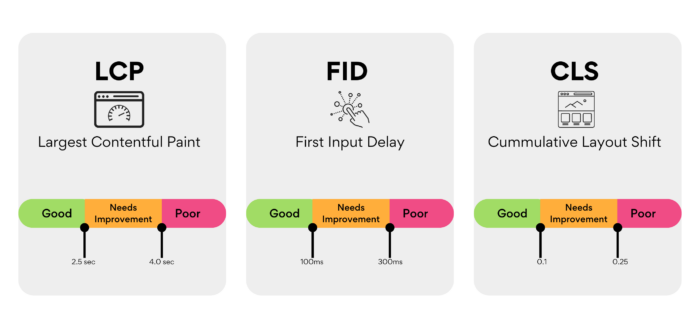
First things first, head over to Google Search Console. This nifty tool shows you how your website is doing in search results. If you’ve got Search Console set up, you can quickly access your site’s live Core Web Vitals reports.
Take a look at your scores. If you see mostly “good URLs,” you’re doing well and can breathe a sigh of relief. If not, it’s time to roll up your sleeves and optimize those Core Web Vitals for better search engine rankings.
Slow pages can drag your whole site down, harming your website’s overall performance and user experience. That’s why it’s crucial to identify any pages with “poor” or “needs improvement” scores.
If your site is new with low traffic, Google might group similar pages together in a URL group, making it easier for you to fix issues across multiple pages at once. Focus on these groups to maximize your optimization efforts.
87%. A study of 6,500 US Ecommerce sites revealed that 87% would fail a Core Web Vitals assessment today. 30% would pass for Cumulative Layout Shift, 38% would pass for Largest Contentful Paint, and 93% would pass First Input Delay.
Now that you’ve discovered which pages need some TLC, it’s essential to monitor your website regularly to spot performance changes as soon as possible. You’ll want to keep a close eye on the following:
1. Pages with low Core Web Vitals: Track the progress of your optimization efforts.
2. High-traffic pages, such as your homepage: These pages are crucial for your website’s success and deserve extra attention.
3. Comparable competitor sites: Keeping tabs on your competition allows you to compare your performance and set benchmarks.
Running performance tests on slow pages is the key to finding out what’s causing those “needs improvement” or “poor” Core Web Vitals scores. Use tools like Google PageSpeed Insights, Lighthouse, or WebPageTest to get detailed insights
Patience is a virtue when it comes to evaluating the results of your optimizations. Keep in mind that it can take up to 30 days for the full effect of your improvements to become apparent once they are implemented and live on your website. This delay is due to the time it takes for search engines to crawl and re-evaluate your site, as well as for user behavior data to be collected and analyzed.
During this waiting period, resist the temptation to tinker with your site further. Instead, monitor your website’s performance and track changes in your Core Web Vitals scores. Remember that fluctuations in your site’s ranking and user engagement can be influenced by various factors, so it’s essential to focus on long-term trends rather than short-term variations.
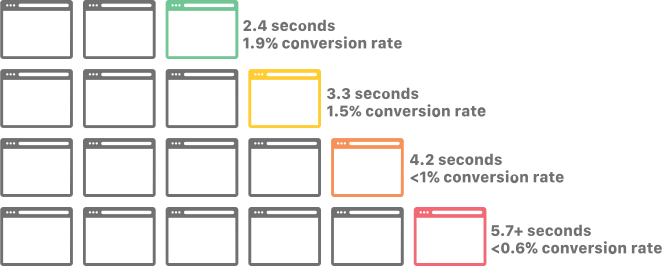
Once you’ve observed the impact of your initial optimizations, take a moment to celebrate your success. Then, it’s time to get back to work! Use the insights you’ve gained from assessing your improvements to identify other areas of your website that could benefit from optimization.
As you continue to fine-tune your site, consider the following:
1. Prioritize optimizations with the most significant potential impact on your Core Web Vitals scores.
2. Look for opportunities to streamline and enhance your site’s design, content, and functionality to provide an even better user experience.
3. Keep an eye on your competitors and stay informed about industry trends and best practices in web design, SEO, and digital marketing.
By maintaining a proactive and iterative approach to optimizing your website, you’ll be well-positioned to achieve long-term success and stay ahead of your competition. And remember, even small changes can yield significant improvements in your website’s performance, user experience, and search engine rankings. So keep pushing forward, and watch your website flourish!

Your website is one of your most powerful marketing tools. It’s a 24/7 salesperson that works tirelessly to promote your business and generate leads. But what good is a website if it doesn’t convert those visitors into customers? If you’re not seeing the results you want, it might be time for a redesign. Keep reading for our guide on how to design a website that converts visitors into customers.
A high-converting website has several key components. First, it must have a clear value proposition that tells visitors what you do and why they should care. Second, it needs to have a strong call to action (CTA) that encourages visitors to take the next step, whether that’s signing up for your email list or scheduling a consultation. Finally, your website must be mobile-friendly so that people can access it no matter where they are or what device they’re using.
If your website is missing any of these elements, don’t worry—there’s still time to make changes. Read on for specific tips on how to add them to your site.
Your value proposition is the first thing people will see when they land on your website, so it’s important to make a good impression. A strong value proposition should be clear, concise, and easy to understand. It should also explain what you do and why someone should care.
For example, if you’re an interior designer, your value proposition might be “Create beautiful, functional, and personalized spaces.”
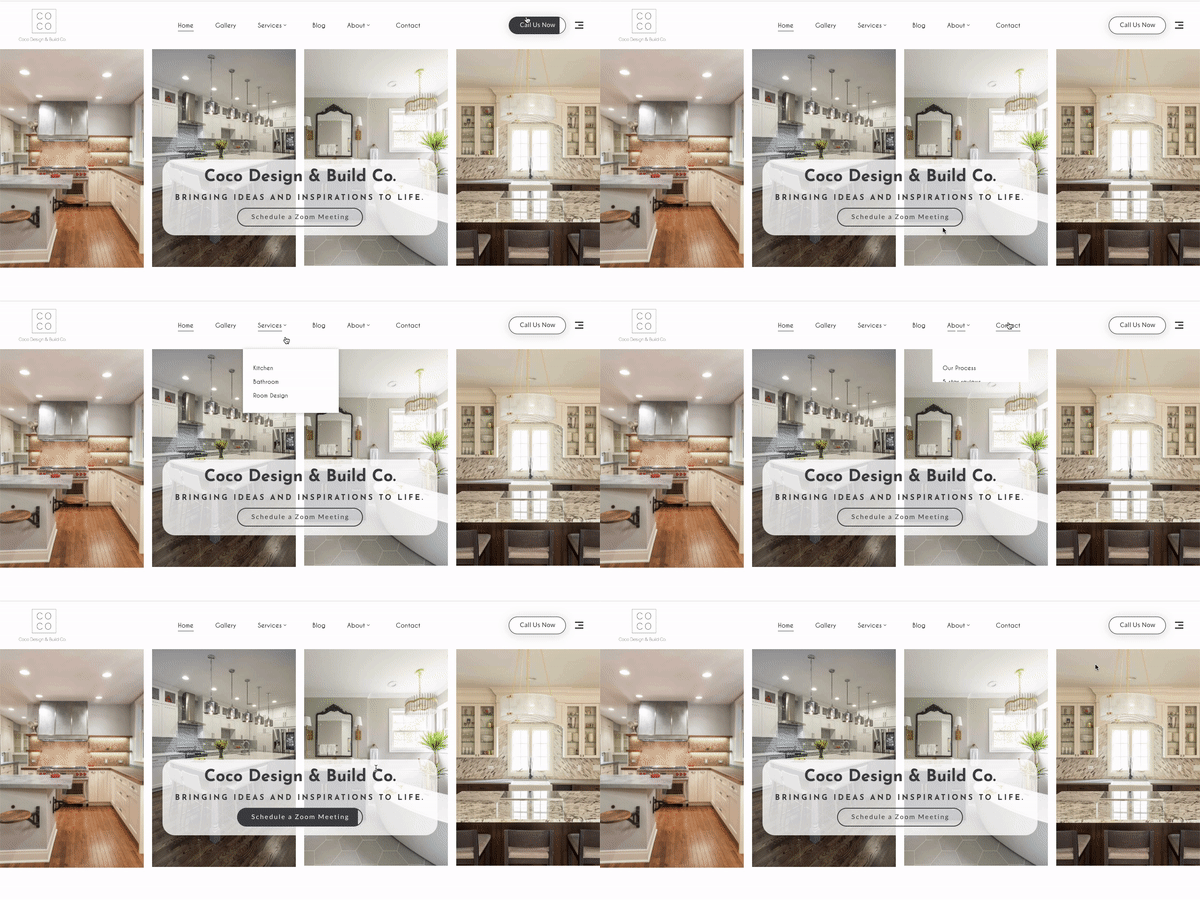
If you’re not sure how to craft an effective value proposition, start by brainstorming all the ways your product or service can help solve someone’s problem. Once you have a list of potential benefits, narrow it down to the one or two that are most important and relevant to your target audience. From there, you can start crafting your value proposition using the following template:
[Insert Your Business Name] + [What You Do] + [Who You Help] = [The Transformation They Can Expect].
For example, Griffon Webstudios + SEO Services + Businesses Looking to Increase Their Online Visibility = More Traffic and More Customers.
Your CTA is what tells visitors what you want them to do next—sign up for your email list, download your e-book, etc.—so it’s important to make it as effective as possible. One way to do this is by using power words in your CTA that elicit an emotional response from readers and encourage them to take action. For example, words like “join,” “save,” “discover,” and “learn” are all great options. You can also use phrases like “get started now” or “find out more” to nudge people in the right direction. Just make sure your CTA is clear and easy to understand so that people know exactly what they need to do next.
More than half of all web traffic now comes from mobile devices like smartphones and tablets, so it’s essential that your website is designed with mobile users in mind. Mobile-friendly websites are easy to navigate on small screens and load quickly—two things that are important for keeping people engaged with your site. If you’re not sure if your website is mobile-friendly, you can use Google’s free Mobile-Friendly Test Tool.
Simply enter your URL and Google will let you know if there are any issues with your site’s design or functionality on mobile devices. You can then make changes as needed so that everyone who visits your site has a positive experience, no matter what device they’re using.
By following these tips, you can design a website that is more likely to convert visitors into customers.
Griffon Webstudios specializes in custom web design services that meet the scalable needs of your business. From local New York startups to international e-commerce giants, we cater our development to your specific challenges and value points so you can get your brand out and generate more business.
Our web design firm uses the latest tech stacks to ensure a reliable and high-quality outcome. We blend clean layouts and interface design with valuable functionality and a desirable aesthetic aligned with today’s trends. That includes leveraging SEO and marketing methods to increase your niche market presence.
Custom web design is a great way to get a website that is unique to your business. This means that it will be built in a way that reflects your brand identity and will make it easier for customers to find information about what you offer. A custom-built site also has the advantage of being designed specifically for your customers, so you’ll have an easier time generating leads and converting them into sales.
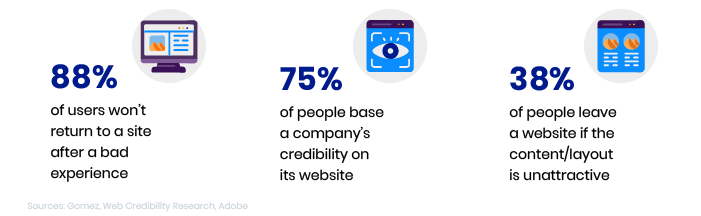
As technology continues to evolve, it’s becoming easier than ever for businesses to launch their own online stores. Websites and applications built on platforms like Shopify make it simple for entrepreneurs to sell products directly from their websites. The problem is these sites all look just like one another, making it near impossible to stand out in the marketplace.
With our web design firm, you get a unique website that allows people all over the world access to your products or services. You’ll be able to connect more closely with customers and integrate sales systems that are trackable, so you’ll know which strategies are working best.
You may have noticed that some websites are easier to use than others, and those are usually designed by someone who knows what they’re doing! A good UI UX Designer will make sure that your site is easy on the eyes, not just in terms of aesthetics but also in terms of its functionality.
For example, if you need your users to be able to find specific information quickly with minimal effort then an experienced UI UX Designer can help design those pages. We build easily accessible sites without making things look cluttered or confusing. Our designers will take into account everything from how many colors should be used on each page down to whether or not certain types of buttons should be used at all.
Having this information straight from someone who knows their stuff means fewer headaches later on down the line when people visit your site. After all, nothing’s worse than having something go wrong because there was no forethought put into any aspect whatsoever!
Griffon Webstudios is here to build a mobile responsive website that focuses on clean design, trendy styles, and optimized conversion rates. Reach out to our team today to revolutionize your online presence with the tailored-made solutions you need to reach more potential leads.

Tell us what you're looking for, our team will get in touch with you.